


Products Description
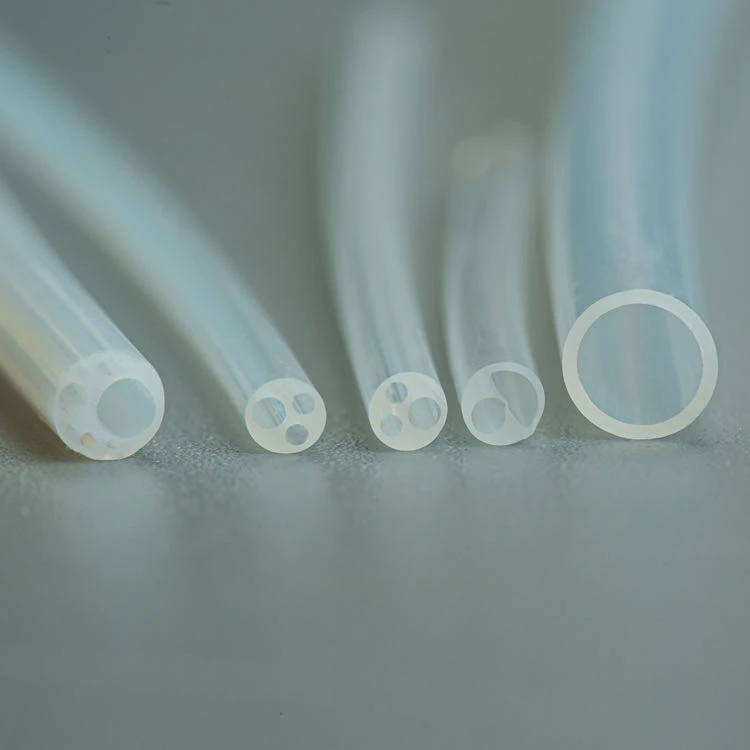
Standard off-the-shelf tubing rarely fits the tight space constraints of modern minimally invasive devices. At WITFLON, we don't keep multi-lumen PTFE tubing in stock. Instead, we extrude it strictly based on your cross-sectional drawings. Whether you need a simple dual-lumen profile or a complex, asymmetrical multi-bore layout, our engineering team will review your design for extrusion feasibility before we even cut the tooling.
Precision-Extruded PTFE Tubing Built Around Your Device Requirements
When your catheter or endoscope design requires multiple isolated channels packed into a tiny outer profile, the real challenge isn't just the outer diameter-it's maintaining the integrity of the thin partition walls between lumens during extrusion.
We don't force your design into our existing molds. You send us your 2D/3D drawings or physical samples, and we evaluate exactly what cross-section we can extrude reliably. From symmetrical dual-channel builds to highly irregular multi-channel layouts, we figure out the tooling and process parameters to make your design a reality.
marketing.
01
Custom PTFE Multi-Lumen Tubing for Medical OEM Manufacturing
A multi-lumen extrusion consolidates several independent pathways into a single tube, saving crucial space inside your device. But every medical device is different. We adjust the design variables strictly according to your functional needs:
Lumen count and spatial arrangement (symmetrical, asymmetrical, or clustered)
Individual inner diameter (ID) for each specific bore
Overall outer diameter (OD) and outer wall thickness
Inter-lumen partition thickness (the critical factor for structural stability)
Cut lengths and specific dimensional tolerances
Before we open any tooling, our engineers will review your drawing to flag high-risk features-like ultra-thin partitions or micro-lumens that might collapse during cooling. We tell you what works and what needs tweaking before you spend money on samples.
02
Custom Multi-Lumen Configurations
Channel layout must serve your device's internal routing. While symmetrical holes are common, many complex catheters require one large central working channel surrounded by smaller auxiliary lumens for guidewires or fluids.
Dual & Triple Lumen: Standard setups for paired fluid pathways, guidewire routing, or combining aspiration with signal wire isolation.
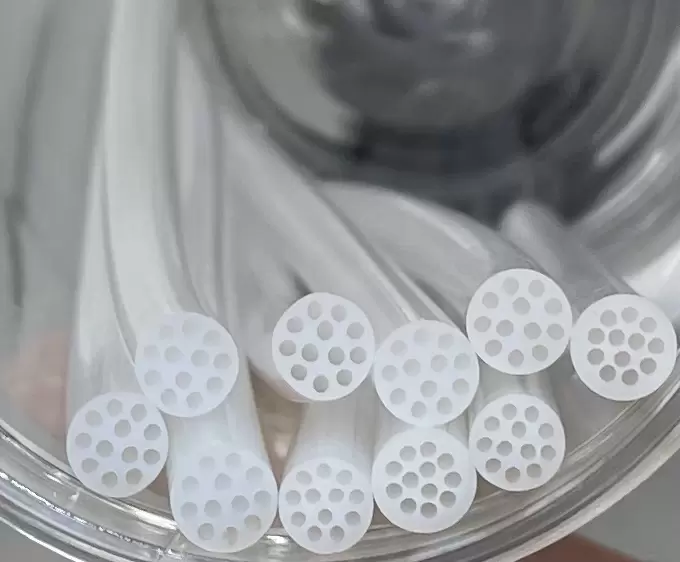
Four-Lumen & Beyond: Used when multiple separate pathways are needed without bundling several single-lumen tubes together.
Asymmetrical & Custom Multi-Bore: Not every project fits standard patterns. We regularly extrude mixed large/small bore combinations and irregular channel placements. The final achievable geometry is always subject to our extrusion feasibility review.
03
Thin-Wall PTFE Multi-Lumen Tubing
In minimally invasive instruments, every micron counts. You often can't increase the tube's OD, so the wall and partition thickness must be pushed to the limit.
Thin-wall multi-lumen extrusion is where our process engineering really matters. If the internal partitions are too thin, the cross-section will distort or collapse as the PTFE cools. When we develop these thin-wall parts, we focus heavily on maintaining consistent IDs, ensuring outer wall integrity, and keeping lumen positioning stable. We need you to clearly mark all critical dimensions and absolute minimum wall limits on your drawing so we can design the extrusion die accordingly.
04
Why We Select PTFE for Medical Multi-Lumen Components
We don't automatically recommend PTFE for every project. We recommend it when its specific properties solve your multi-lumen design challenges:
Low Friction: Crucial when guidewires or mechanical cables need to slide repeatedly through tight, curved internal channels without binding.
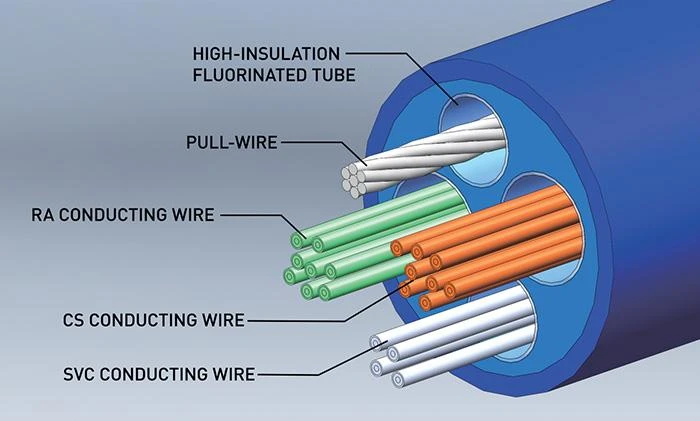
Dielectric Insulation: Essential when routing conductive signal wires alongside fluid channels in electrosurgical tools.
Chemical & Thermal Stability: PTFE handles clinical fluids and harsh sterilization cycles, though final compatibility and sterilization validation remain the device manufacturer's responsibility.
Non-Stick Bore: Prevents residue buildup during fluid delivery or aspiration, which is critical for maintaining consistent flow in micro-lumens.
Applications
Catheter Systems
Liners for guidewire ports, contrast delivery, and aspiration.
Laparoscopic Tools
Separate pathways for insufflation, irrigation, and suction.
Endoscopic Instruments
Packing gas, liquid, and wiring channels into tight working spaces.
Electrosurgical Devices
Insulated multi-channel liners for energy delivery and fluid management.
Dimensional Inspection & Quality Control


FAQ
Q: Can you produce multi-lumen tubing strictly to our drawing?
A: Yes, our process is 100% drawing-led. However, we will review it first. If a partition wall is too thin to survive the extrusion process without collapsing, we will tell you and suggest a slight design modification before we build the tooling.
Q: How many lumens can you extrude in one PTFE tube?
A: We regularly do 2, 3, and 4 lumens. We've done more, but it strictly depends on the overall OD and the minimum stable partition thickness. Send us the drawing, and we'll tell you if it's manufacturable.
Q: Can each lumen have a different inner diameter?
A: Yes, mixed bore sizes are very common (e.g., one large central lumen for a camera, surrounded by smaller lumens for wires). The layout just needs to be balanced enough for the PTFE to flow evenly through the die.
Q: What tolerance can you actually hold on the internal lumens?
A: For standard single-lumen tubes, we hold ±0.03 mm. For multi-lumen, especially with thin partitions, the internal tolerances might be ±0.05 mm or slightly wider depending on the complexity. We will confirm the exact achievable tolerance during the drawing review phase.
Q: Is this tubing ready for implantation or patient contact?
A: We supply the raw extruded component. While we use medical-grade PTFE resin and run it in a cleanroom under ISO 13485, final biocompatibility testing and regulatory clearance for patient contact must be done by you, the device manufacturer.
Q: Can this tubing survive EtO or Gamma sterilization?
A: PTFE material itself handles EtO, Gamma, and E-beam sterilization very well. However, the physical dimensions of thin-wall multi-lumen structures can sometimes shift under extreme thermal or radiation stress. You must validate the sterilization cycle on your finished device.


