


3D printer PTFE Tube 2x4mm For 1.75mm Filament 2.5mm x 4mm
The 3D printer PTFE tube is manufactured using PTFE resin through a precision extrusion process. PTFE raw material is first prepared and processed according to the required material grade and tube specification.
During extrusion, the PTFE material is formed through a precision die to produce the required inner and outer diameters. For common 3D printer applications, sizes such as 2mm ID × 4mm OD and 2.5mm ID × 4mm OD can be produced according to the printer and filament feeding system.
After extrusion, the tube passes through controlled cooling and sizing processes to maintain dimensional consistency. The tubing is then inspected for inner diameter, outer diameter, wall thickness, surface condition, straightness, and length.
The finished PTFE tube can be supplied in continuous rolls or cut to specified lengths. Custom dimensions, tolerances, colors, and packaging are available according to customer requirements.
●Designed for 1.75mm 3D printer filament
●Common size: 2mm ID × 4mm OD
●Alternative size: 2.5mm ID × 4mm OD
●Smooth internal surface for filament movement
●Low-friction PTFE material
●Suitable for Bowden-style filament feeding systems
●Lightweight and easy to cut to required lengths
●Available in continuous rolls or custom-cut sections
●Suitable for different 3D printer configurations
●Custom ID, OD, length, and tolerance available
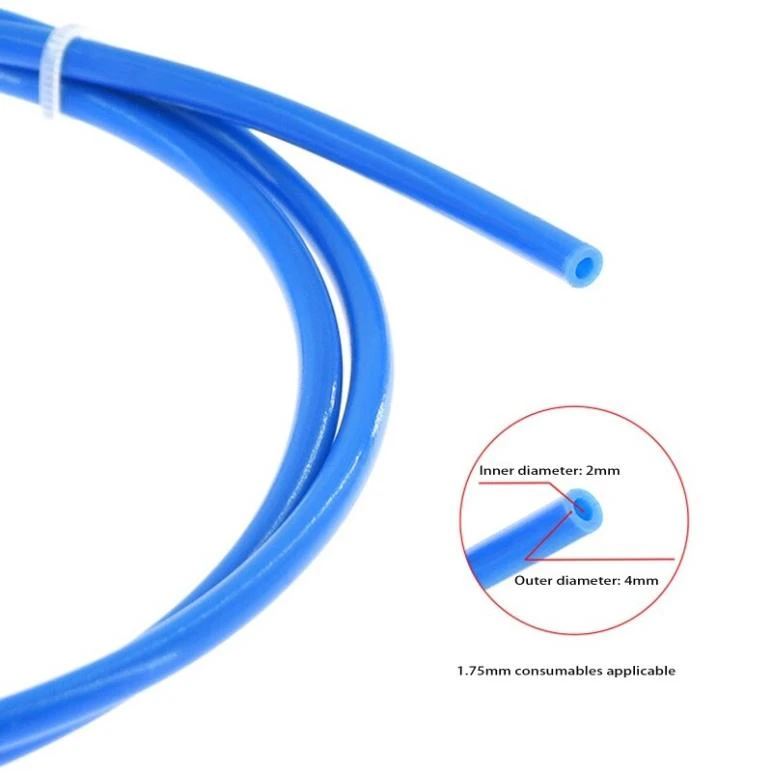
2mm ID x 4mm OD PTFE Tubing
This is the standard, widely-used size for 1.75mm filament in most Bowden-style 3D printers.
• Tighter Tolerance: The closer fit to the 1.75mm filament minimizes the space for the filament to bend or jam, which helps with more accurate prints and less retraction.
• Reduced Slippage: The tight fit lessens the chance of filament slippage or wear on the extruder gears.
• Optimal for Standard Filaments: It works well with common filaments like PLA and ABS. The premium Capricorn XS PTFE tubing is a specific, high-quality option known for its very precise 1.9mm or 2.0mm ID for this purpose.
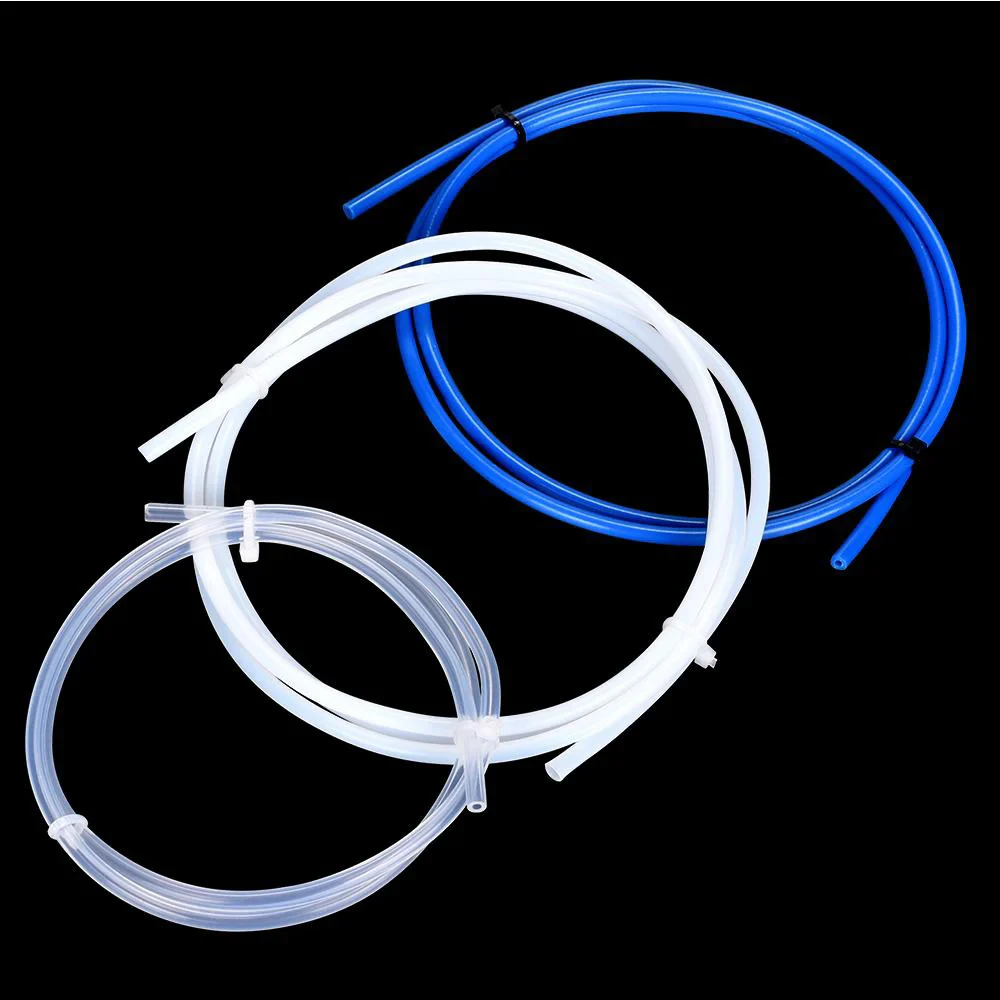
Available Size:2*4mm Color:white,blue,red etc. Package:100meters/roll
2.5mm ID x 4mm OD PTFE Tubing
This variant is specifically designed to provide a bit more clearance for certain applications and printer types.
• Smoother Feeding: The larger inner diameter allows the filament to pass through more smoothly, which is beneficial for reducing the risk of clogging.
• Ideal for Direct Drive Systems: This size is often recommended for direct drive extruders and specific models like those in the Bambu Lab A1/P1P/X1C and Creality K1 series.
• Softer Filament Compatibility: The extra room can be advantageous when printing with softer or more flexible filaments like TPU and TPE, where a tighter fit might cause too much drag or buckling.
• Lower Friction for High Speed: The reduced resistance helps in achieving stable filament transmission, which is crucial for high-speed printing.
Available Size:2.5*4mm Color:grey Package:100meters/roll

Key Features and Benefits
Low Friction
The smooth PTFE inner surface allows 1.75mm filament to pass through with reduced friction.
01
Temperature Resistance
PTFE can withstand the elevated temperatures associated with many 3D printer hot-end and filament feeding applications.
02
Low Moisture Absorption
PTFE has low water absorption, which is useful in environments where moisture resistance is required.
03
Electrical Insulation
PTFE provides electrical insulation when used around wires or electronic components.
04

Application Characteristics
The main function of the PTFE tube in a 3D printer is to guide and protect the filament between the filament drive system and the hot end.
For a 2mm ID × 4mm OD tube, the 2mm internal diameter provides clearance for 1.75mm filament while maintaining a relatively controlled filament path. This configuration is commonly used in Bowden-type extrusion systems.
The 2.5mm ID × 4mm OD version provides a larger internal clearance and can be selected according to the printer structure, filament movement requirements, or specific extruder and hot-end design.
The smooth internal surface helps reduce resistance as the filament moves through the tube. This can support consistent filament feeding and reduce unnecessary contact between the filament and the tube wall.
For flexible filaments or applications requiring tighter filament guidance, the appropriate ID, tube length, routing radius, and extruder configuration should be considered together.
Payment & Shipment
|
Packing |
Carton / Pallet / Wooden Box |
|
Shipping method |
DHL, FedEx, UPS, Air Freight, Sea Freight, EXW, FOB, CIF, DDP, Negotiable. |
|
FOB Port |
Shenzhen,Shanghai ,Negotiable |
|
Production time |
Depends on your qty(3~15 days) |
|
OEM/ODM |
Available |
|
Payment |
T/T, PayPal, Trade Assurance, Negotiable |
FAQ
Q1:What is the difference between 2×4mm and 2.5×4mm PTFE tubing?
A:Both tubes have a 4mm outer diameter, while the internal diameters are different.
2mm ID × 4mm OD: Provides closer filament guidance and is commonly used for 1.75mm filament.
2.5mm ID × 4mm OD: Provides more internal clearance and can be selected according to the printer design and filament feeding requirements.
Q2:What is the main function of the PTFE tube in a 3D printer?
A:The tube provides a guided pathway for filament between the extruder and hot end. It can help reduce filament friction, protect the filament path, and maintain consistent routing within the printer.
Q3:Can the PTFE tube be used as a Bowden tube?
A:Yes. The 2×4mm PTFE tube is commonly used as a Bowden tube for 1.75mm filament, provided that its dimensions and temperature rating are compatible with the specific printer and hot-end assembly.
Q4:Can this PTFE tube be used near the hot end?
A:PTFE has good temperature resistance, but the actual allowable temperature depends on the PTFE grade and application conditions. When the tube is installed close to the heater, the printer's hot-end design and the manufacturer's recommended temperature limits should be considered.
Q5:Does the smooth inner surface affect filament feeding?
A:Yes. The smooth PTFE inner surface helps reduce contact resistance between the filament and tube wall, which can support smoother filament movement through the filament guide.
Q6:Can the PTFE tube be cut to custom lengths?
A:Yes. The tubing can be supplied in continuous rolls or cut to specified lengths. Clean and square tube ends are recommended for proper connection with pneumatic fittings or other printer components.
Q7:Can it be used with different 3D printing filaments?
A:It can be used with many common thermoplastic filaments, but compatibility depends on the filament material, printing temperature, filament diameter, and printer configuration. The appropriate PTFE grade and tube specification should be selected for higher-temperature materials.
Q8:Can you provide custom sizes?
A:Yes. Custom PTFE tubing can be produced according to drawings, samples, or specifications. Inner diameter, outer diameter, wall thickness, length, tolerance, color, and packaging can be customized.
Q9:How should I select the correct PTFE tube size?
A:Selection should consider the filament diameter, required internal clearance, tube length, routing radius, extruder design, hot-end structure, and operating temperature. For standard 1.75mm filament, 2mm ID × 4mm OD is a commonly used configuration.
Q10:Can you supply PTFE tubes for OEM 3D printer manufacturers?
A:Yes. OEM and custom production are available. Customers can provide a drawing, sample, printer specification, or required ID × OD and length, and the tubing can be manufactured according to the confirmed specifications.


