

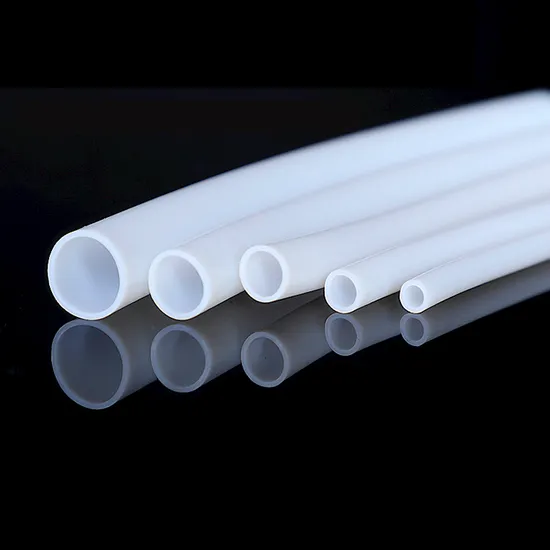
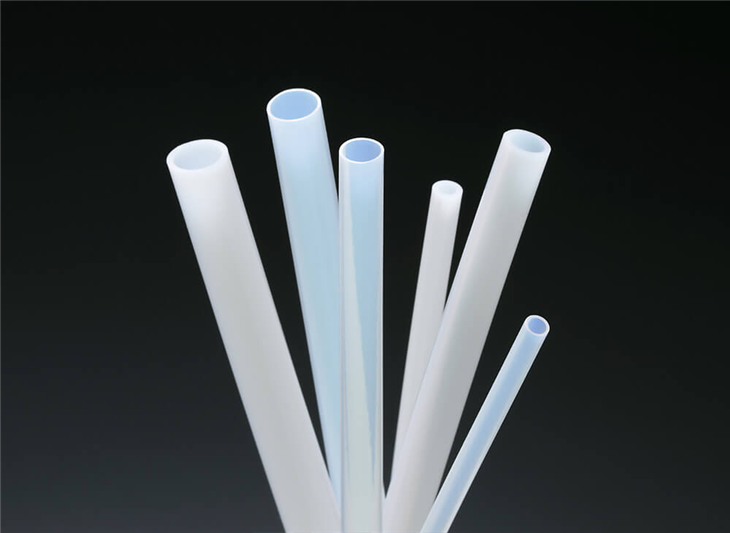
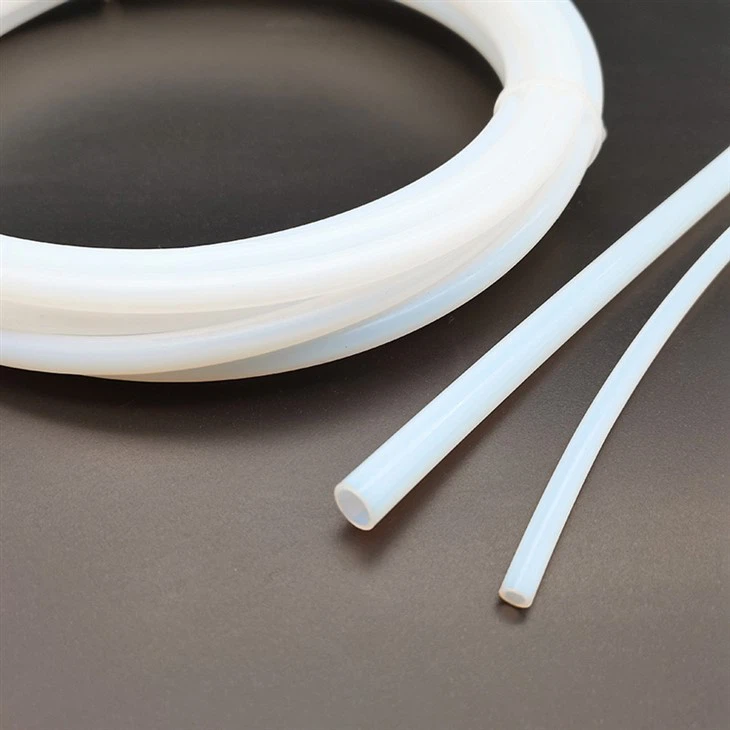
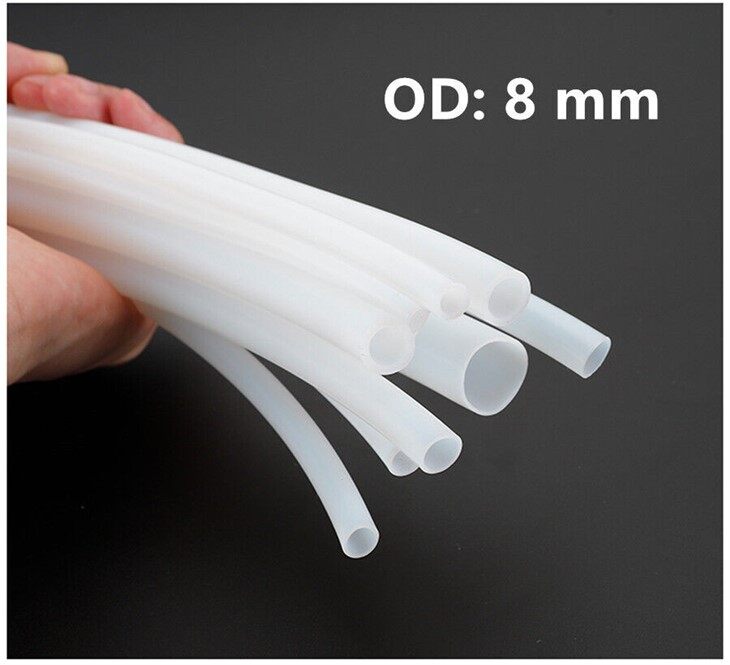
Heat Resistance Teflon Tube AN6 AN8 AN10 AN12 High Pressure PTFE Fuel Oil Brake Hose
Product Manufacturing Process
The PTFE tube is manufactured using PTFE dispersion resin through a controlled extrusion process. The raw material is inspected and prepared before forming to maintain consistent material properties and dimensional stability.
The production process generally includes:
PTFE Raw Material Preparation
Selected PTFE resin is screened and prepared according to the required tube grade, size and application.
Preforming
The PTFE material is compressed into a preform with controlled density to ensure uniform material structure.
Extrusion Forming
The preform is extruded through a precision die to form the tube. Die design and extrusion parameters are adjusted according to the required various size.
Sintering
The extruded tube is heated under controlled conditions to sinter the PTFE and develop its required mechanical and thermal properties.
Cooling and Dimension Control
The tube is gradually cooled and checked for inner diameter, outer diameter, wall thickness and surface condition.
Cutting and Inspection
Finished tubing can be supplied in continuous lengths or cut to specified lengths. Dimensional inspection and appearance checks are performed before packaging.
For applications requiring higher pressure resistance, the PTFE tube can also be used as the inner liner of a reinforced hose assembly with suitable braid or outer protection.
This PTFE tube is manufactured from fluoropolymer material through controlled extrusion and sintering processes. It features a smooth inner surface, low friction, heat resistance, chemical resistance and good electrical insulation properties. AN6, AN8, AN10 and AN12 sizes are available for different hose assembly requirements.
The tubing can be used as a PTFE liner or fluid-transfer tube in automotive, hydraulic, industrial fluid transfer, brake-related hose assemblies and other applications requiring a combination of temperature resistance, chemical resistance and low-friction fluid flow. Reinforced hose construction can be selected according to the required working pressure, flexibility and installation conditions.
Key Features
Heat Resistant PTFE Material
PTFE provides good resistance to elevated temperatures and maintains stable performance across a wide operating temperature range.
Chemical Resistance
The fluoropolymer material offers resistance to many chemicals, solvents and corrosive media.
Low Friction Inner Surface
The smooth PTFE bore reduces friction during fluid flow and helps minimize material adhesion inside the tube.
Non-Stick Surface
The low-surface-energy PTFE inner wall helps reduce deposits and makes the tubing suitable for fluid transfer applications.
Electrical Insulation
PTFE has good dielectric properties, making it suitable for applications where electrical insulation is required.
Low Moisture Absorption
PTFE has very low water absorption, supporting dimensional stability in humid operating environments.


Applications
- Automotive Hose Systems:PTFE tubing can be used as a fluid-transfer liner in automotive hose assemblies where temperature resistance, chemical resistance and low friction are required.
- Brake and Hydraulic Systems:PTFE can be used as an inner liner in certain brake and hydraulic hose assemblies, particularly where low friction and chemical resistance are required.
- Industrial Fluid Transfer:PTFE tubing is suitable for industrial fluid transfer systems involving chemicals, solvents and other demanding media.
- Hydraulic Equipment:PTFE-lined hoses can be used in hydraulic equipment and machinery where the selected hose construction meets the required pressure and temperature conditions.
- Fuel and Fluid Transfer:For the specific title you provided, the product can be positioned for fuel and fluid transfer applications where the PTFE grade and complete hose assembly are compatible with the intended medium.
- Motorsports and Performance Vehicles:PTFE-lined hose assemblies are commonly considered for applications requiring compact routing, chemical resistance and temperature resistance.
Key Benefits
High-Pressure Hose Assembly Compatibility
PTFE tubing can be combined with stainless steel braid or other suitable reinforcement to form hose assemblies for higher-pressure applications. The actual pressure rating depends on the complete hose construction, fittings and operating conditions.
01
Flexible Hose Routing
When used in a properly designed reinforced hose assembly, the PTFE liner can accommodate flexible routing around machinery, automotive components and compact installation areas.
02
Reduced Fluid Contamination
PTFE has a smooth, non-stick inner surface and low material reactivity with many fluids. This can help reduce adhesion and minimize the risk of particles or residues from the tube material entering the fluid system.
03
Easy Integration with Hose Fittings
The tubing can be assembled with compatible AN fittings and reinforcement structures, allowing it to be incorporated into customized hose assemblies for automotive and industrial equipment.
04
Suitable for Customized Hose Solutions
Tube dimensions, length, reinforcement structure and connection configuration can be selected according to the customer's application requirements, installation space and working conditions.
05


Payment&Shipping
|
Packing |
Carton / Pallet / Wooden Box |
|
Shipping method |
DHL, FedEx, UPS, Air Freight, Sea Freight, EXW, FOB, CIF, DDP, Negotiable |
|
FOB Port |
Shenzhen,Shanghai ,Negotiable |
|
Production time |
Depends on your qty(3~15 days) |
|
OEM/ODM |
Available |
|
Payment |
T/T, PayPal, Trade Assurance, Negotiable |
FAQ
Q1:What temperature range can PTFE tubing withstand?
A: Standard PTFE tubing can typically be used across a wide temperature range, depending on the grade, dimensions, pressure, and working conditions. Please contact us for the recommended temperature range for your application.
Q2:Can PTFE tubing be customized?
A: Yes. We can provide customized inner diameter, outer diameter, wall thickness, length, color, and other specifications according to customer requirements. Custom profiles and special structures can also be discussed.
Q3:Can you provide samples before bulk production?
A: Yes. Samples can be provided for specification confirmation and application testing before placing a bulk order.
Q4:Is PTFE tubing flexible?
A: PTFE tubing has some flexibility, but the flexibility depends on tube diameter, wall thickness, and construction. Thin-wall tubing provides greater flexibility than heavy-wall tubing.
Q5:What shipping methods are available?
A: We can arrange express delivery, air freight, sea freight, or shipment through the customer's nominated forwarder. EXW, FOB, CIF, and DDP terms can be discussed.
Q6:What information is required for a customized PTFE tube?
A: Please provide the required ID, OD, wall thickness, length, material grade, operating temperature, working pressure, application, and quantity. Drawings or samples are also helpful for customized products.
Specifications & Performance
These hoses are designed for high-performance applications and offer excellent resistance to heat, corrosion, and a wide range of fluids, including E85 ethanol, methanol, and brake fluid.
| AN Size | Approx.Immer Diameter | Max.Working Pressure (Typical) | Temperature Ranger (Typical) |
| AN6 | 0.32in(8.2mm) | 3000PSI | -85°F to 500°F (-60°C to 260°C |
| AN8 | 0.42in(10.8mm) | 2500PSI | -85°F to 500°F (-60°C to 260°C |
| AN10 | 0.50in(13.0mm) | 2000PSI | -85°F to 500°F (-60°C to 260°C |
| AN12 | 0.64in(16.2mm) | 1500PSI | -85°F to 500°F (-60°C to 260°C |


