

What Do ID, OD and Wall Thickness Mean?

1. Inner Diameter (ID)
Inner Diameter (ID) refers to the diameter of the inside opening of the PTFE tube.
It determines the available space for fluid, gas, wire, or filament to pass through.
The ID directly affects:
Flow rate
Pressure drop
Material compatibility
Installation fit
For example, a PTFE tube with a larger ID allows more fluid flow, while a smaller ID provides better control for precision applications.
Common applications where ID is critical include:
Medical fluid transfer
Laboratory equipment
Chemical sampling systems
3D printer Bowden tubes
2. Outer Diameter (OD)
Outer Diameter (OD) refers to the total outside diameter of the PTFE tubing.
The OD is important when the tube needs to fit into connectors, fittings, clamps, or equipment assemblies.
A correct OD ensures:
Proper connection with fittings
Secure installation
Mechanical stability
For example, many industrial customers specify PTFE tubing based on OD because the tube must match a specific fitting or connector size.
3. Wall Thickness
Wall thickness is the distance between the inner and outer walls of the PTFE tube.
It can be calculated by:
Wall Thickness = (OD - ID) / 2
Wall thickness influences:
Pressure resistance
Mechanical strength
Flexibility
Temperature performance
Generally:
Thicker walls provide higher mechanical strength
Thinner walls provide better flexibility
The ideal wall thickness depends on the working conditions and application requirements.
How to Select the Right PTFE Tubing Size?
1. Consider the Application Requirements
The first step is understanding how the PTFE tube will be used.
Different applications require different dimensions.
Fluid Transfer Applications
For liquid or gas transportation, consider:
Required flow rate
Fluid viscosity
Working pressure
Connection size
A larger ID may be needed for higher flow requirements.
Medical Applications
Medical PTFE tubing usually requires precise dimensions and tight tolerances.
Important factors include:
Small and consistent ID
Smooth inner surface
Biocompatibility requirements
Dimensional accuracy
Common applications include:
Catheter components
Medical instruments
Diagnostic equipment
Electrical and Wire Protection
For wire insulation applications, the tube size should match:
Cable diameter
Required insulation thickness
Assembly space
PTFE heat shrink tubing and thin-wall PTFE tubing are commonly used in these applications.
PTFE Tubing Size Selection Factors

1. Fluid Flow Requirements
The inside diameter determines how much fluid can pass through the tube.
If the ID is too small:
Flow resistance increases
Pressure loss may occur
If the ID is too large:
The system may become less efficient
Installation space may increase
Selecting the right ID helps maintain stable system performance.
2. Working Pressure
The pressure capability of PTFE tubing depends on several factors:
Tube diameter
Wall thickness
Temperature
Application conditions
Generally, smaller diameter tubing with thicker walls can withstand higher pressure.
For high-pressure applications, customers usually select reinforced or thicker-wall PTFE tubing.
3. Temperature Conditions
PTFE has excellent temperature resistance, typically operating from approximately -200°C to +260°C.
However, temperature can affect:
Mechanical strength
Pressure rating
Tube flexibility
The correct tube size should be selected based on the actual operating environment.
4. Installation Space
Available installation space is another important consideration.
For compact equipment, customers may require:
Small OD tubing
Thin-wall PTFE tubing
Capillary tubing
For industrial systems, larger OD tubing may be preferred for easier installation and higher flow capacity.
Common PTFE Tubing Size Examples

PTFE Capillary Tubing
Typical characteristics:
Small ID
Precise tolerance
Thin wall
Applications:
Medical devices
Laboratory instruments
Precision fluid systems
Standard PTFE Tubing
Typical characteristics:
Various ID and OD options
Suitable for general industrial use
Applications:
Chemical transfer
Pneumatic systems
Equipment connection
PTFE Tube for 3D Printers
Common requirements:
Smooth inner surface
Low friction
Accurate ID
The tube size must match the filament diameter and hot end structure.
Custom PTFE Tubing Dimensions
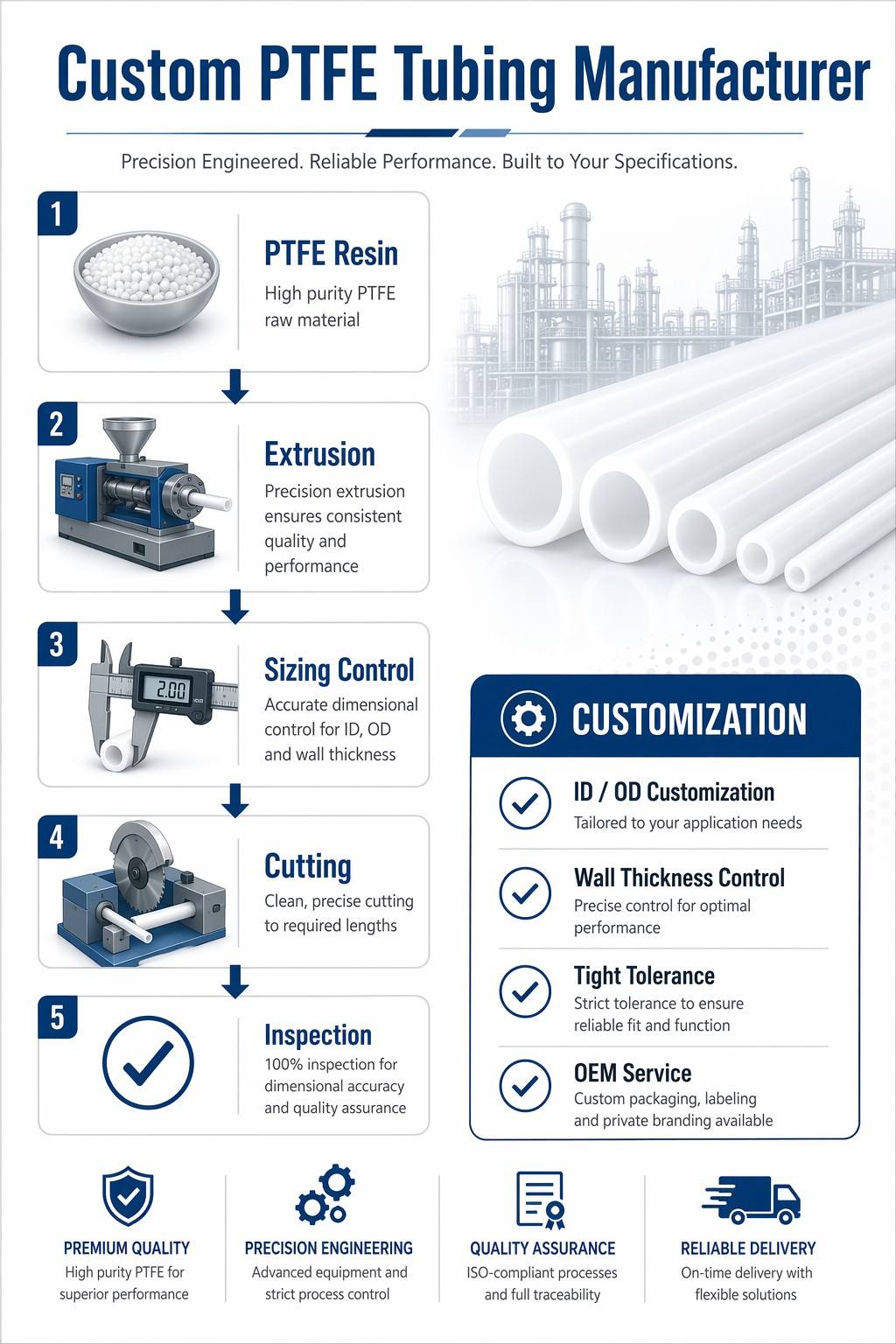
Different industries may require customized PTFE tubing sizes beyond standard specifications.
Customization options include:
Custom ID and OD
Different wall thicknesses
Tight dimensional tolerance
Different lengths
Custom colors
Special structures
At Witflon, we provide customized PTFE, FEP, and PFA tubing solutions according to customer drawings, samples, or application requirements.
PTFE Tubing Size Selection Checklist
Before ordering PTFE tubing, confirm the following information:
✓ Inner Diameter (ID)
✓ Outer Diameter (OD)
✓ Wall Thickness
✓ Length requirement
✓ Temperature range
✓ Working pressure
✓ Chemical compatibility
✓ Application environment
Providing accurate specifications helps ensure the tubing performs reliably in your system.
Conclusion
Selecting the right PTFE tubing size is essential for achieving stable performance and long service life.
By understanding the relationship between ID, OD, and wall thickness, engineers and buyers can choose tubing that matches their flow requirements, installation conditions, and operating environment.
Whether you need standard PTFE tubing or a custom solution, working with an experienced PTFE tubing manufacturer can help you find the right specification for your application.