

Rigid vs Flexible PTFE Tubing
PTFE tubing is available in both relatively rigid and flexible constructions. The difference is not simply the PTFE material itself. Tube diameter, wall thickness, length, temperature and tube structure all affect how easily a PTFE tube can bend.
WITFLON manufactures standard PTFE tubing, thin-wall PTFE tubing, PTFE capillary tubing, corrugated/convoluted tubing, heat-shrink tubing and braided PTFE hose. This gives buyers several options when the same PTFE material needs to work in very different mechanical conditions.
A rigid PTFE tube is normally selected when dimensional stability, straight routing and mechanical support are more important.
A flexible PTFE tube is selected when the tubing needs to bend around components, fit into a compact assembly or accommodate movement.

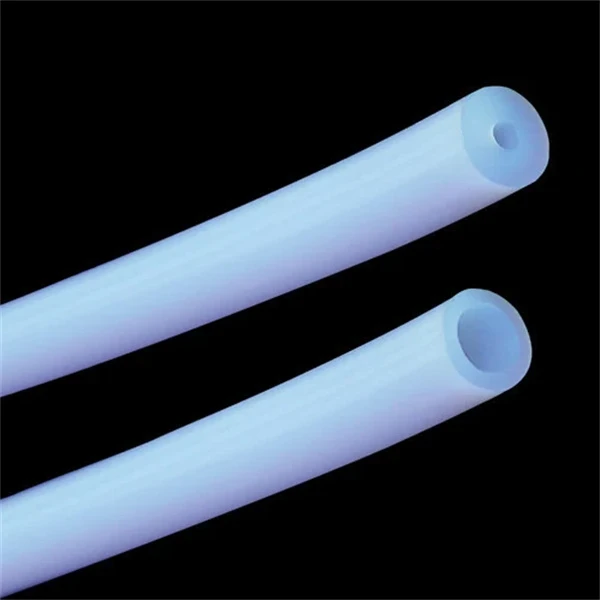

Rigid vs Flexible PTFE Tubing: Quick Comparison
| Item | Rigid PTFE Tubing | Flexible PTFE Tubing |
|---|---|---|
| Main feature | Dimensional stability | Bending ability |
| Typical wall | Standard or thick wall | Thin wall or flexible structure |
| Bend radius | Larger | Smaller |
| Shape retention | Better | Lower |
| Installation | Straight or supported routing | Curved or complicated routing |
| Vibration | Limited movement | Better suited to movement |
| Pressure capability | Can be high with thick wall | Depends strongly on wall and structure |
| Mechanical strength | Higher in thick-wall designs | Depends on construction |
| Weight | Usually higher for thick-wall tubes | Often lower |
| Tight spaces | Less suitable | More suitable |
| Flow path | Usually smooth | Can be smooth or corrugated |
| Typical products | Rigid PTFE tube, thick-wall tube | Thin-wall, capillary, convoluted, braided |
| Typical applications | Chemical lines, insulation, equipment piping | Medical devices, moving connections, compact equipment |
| Main selection factor | Wall thickness and dimensions | Flexibility and bend radius |
1. What Makes a PTFE Tube Rigid or Flexible?
PTFE itself has a certain degree of flexibility, but a finished tube can behave very differently depending on its construction.
The main factors are:
● Tube diameter
● Wall thickness
● Tube length
● Temperature
● Material grade
● Internal structure
● External reinforcement
WITFLON's PTFE tubing FAQ specifically identifies these factors when discussing tubing flexibility. Thin-wall PTFE is more flexible, while thick-wall PTFE is more rigid. Corrugated/convoluted and braided constructions provide additional options for applications requiring bending or movement.
This means that saying "PTFE tubing is flexible" is not enough for an engineering specification.
A buyer should specify the actual tube dimensions and the required bend radius.
Image suggestion:
Three PTFE tubes with the same material but different wall thicknesses, showing how thick-wall PTFE remains straight while thin-wall PTFE bends more easily.


2. What Is Rigid PTFE Tubing?
Rigid PTFE tubing generally uses a thicker wall or larger cross-section to provide greater dimensional stability.
WITFLON's product range includes Chemical Rigid Teflon PTFE Tubing, alongside standard PTFE tubes and other structures.
Rigid PTFE tubing is useful when the tube needs to:
● Maintain its shape
● Follow a relatively straight route
● Resist deformation during installation
● Provide stable internal dimensions
● Operate under pressure
● Act as a protective liner
● Maintain a defined position inside equipment
Typical applications
● Chemical transfer lines
● Laboratory equipment
● Equipment liners
● Electrical insulation
● Wire and cable protection
● Semiconductor equipment
● Industrial machinery
● Fluid connections
● High-temperature equipment
A rigid tube does not necessarily mean that the tube cannot bend at all. It means that bending requires more force and a larger radius than a thin-wall or convoluted construction.
Image suggestion:
Rigid PTFE tubes installed in straight chemical process lines and laboratory equipment, with clean industrial fittings.

3. What Is Flexible PTFE Tubing?
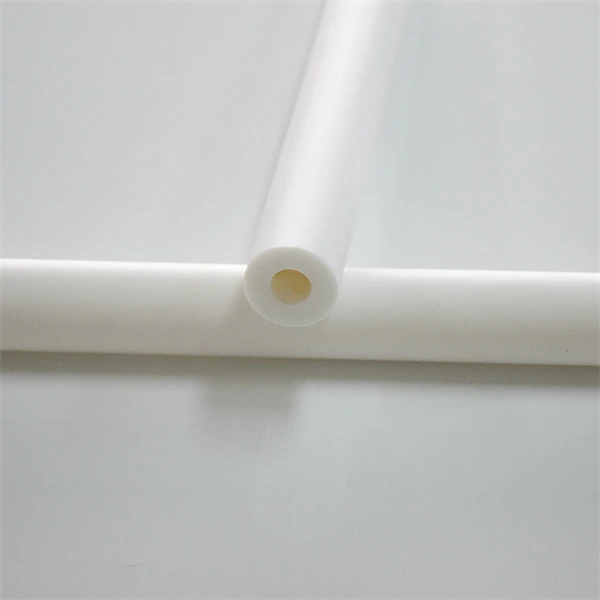
Flexible PTFE tubing is designed to bend more easily during installation or operation.
The simplest way to increase flexibility is to reduce wall thickness, but WITFLON also offers structures specifically designed for flexibility.
These include:
● Thin-wall PTFE tubing
● PTFE capillary tubing
● Corrugated PTFE tubing
● Convoluted PTFE tubing
● Braided PTFE hose
WITFLON's FAQ explains that thin-wall tubing is more flexible than thick-wall tubing, while convoluted tubing uses a corrugated structure to improve bending performance.
The flexible PTFE range therefore covers more than one type of product.
Typical applications
● Medical devices
● Catheter components
● Laboratory instruments
● Compact fluid systems
● Sensor protection
● Moving equipment
● Automotive systems
● Chemical equipment
● Semiconductor equipment
● Electrical assemblies
Image suggestion:
Flexible PTFE tubing routed through a compact medical or industrial assembly with several bends and limited installation space.


4. Rigid vs Flexible PTFE Tubing: Wall Thickness
Wall thickness has a direct effect on flexibility.
For the same material and approximate diameter:
Thicker wall → greater rigidity
Thinner wall → easier bending
A thick-wall PTFE tube may be appropriate when pressure resistance and dimensional stability are important.
A thin-wall PTFE tube can reduce the overall OD and make routing easier, especially when the tube is used as a liner or in a compact assembly.
WITFLON's custom PTFE tubing service allows customers to specify inner diameter, outer diameter and wall thickness rather than selecting only from fixed catalogue dimensions.
Example
A project may require:
● ID: fixed for fluid flow
● OD: limited by installation space
● Wall thickness: reduced to improve flexibility
In another project, the requirement may be the opposite:
● ID: fixed
● OD: less restrictive
● Wall thickness: increased for mechanical strength and pressure capability
The same PTFE material can therefore be used in very different tube constructions.
Image suggestion:
Cross-sectional diagram showing thin-wall and thick-wall PTFE tubing with the same ID but different OD and wall thickness.

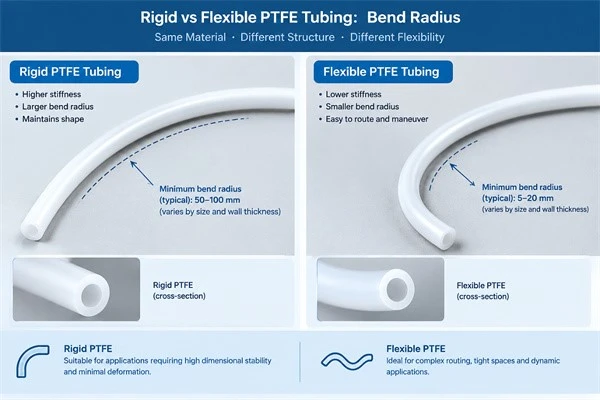
5. Rigid vs Flexible PTFE Tubing: Bend Radius
Bend radius is one of the most useful specifications when choosing flexible PTFE tubing.
A rigid PTFE tube normally requires a larger bending radius. If it is forced into a tight curve, the tube can deform or become damaged.
Flexible structures are designed to accommodate smaller bending radii.
WITFLON's corrugated/convoluted PTFE tubing uses repeated convolutions to improve flexibility and provide a smaller bend radius than ordinary smooth PTFE tubes.
For a tubing RFQ, it is better to state:
"Minimum bend radius: XX mm"
rather than simply asking for:
"Flexible PTFE tube."
This gives the manufacturer a measurable design requirement.
Image suggestion:
Engineering comparison showing rigid PTFE tubing with a large bend radius and flexible corrugated PTFE tubing with a much smaller bend radius.
6. Smooth Flexible PTFE Tubing vs Corrugated PTFE Tubing
Not every flexible PTFE tube has a corrugated wall.
There are two different approaches.
Thin-Wall Smooth PTFE Tubing
The internal and external surfaces remain relatively smooth.
Flexibility comes mainly from the reduced wall thickness and tube dimensions.
This structure is useful when the internal passage needs to remain smooth.
Typical applications include:
● Medical liners
● Capillary tubing
● Laboratory fluid transfer
● Electrical insulation
● Small-diameter tubing
Corrugated / Convoluted PTFE Tubing
The tube wall contains repeated convolutions.
The structure allows the tube to bend more easily and provides a smaller bending radius.
WITFLON's corrugated PTFE product page specifically describes the convoluted structure as providing high flexibility and a smaller bending radius than ordinary smooth PTFE tubes.
Typical applications include:
● Equipment connections
● Moving machinery
● Tight installation spaces
● Automotive systems
● Chemical equipment
● Vacuum systems

7. Rigid PTFE Tubing for Pressure Applications
A rigid PTFE tube can be useful when the tube needs greater wall thickness.
Pressure capability depends on several variables:
● ID
● OD
● Wall thickness
● Temperature
● Tube length
● Material grade
● Reinforcement
● Installation conditions
WITFLON states that there is no single pressure rating for all PTFE tubing. A smaller tube with a thicker wall can generally support higher pressure than a thin-wall tube made from the same material. For higher-pressure applications, reinforced PTFE hose and stainless steel braided PTFE hose are also available.
Therefore, a buyer should not choose a rigid tube simply because it "looks stronger."
The actual working pressure and temperature need to be checked against the tube construction.
8. Flexible PTFE Tubing for Moving Equipment
Flexible tubing becomes more useful when the connection itself has to accommodate movement.
Examples include:
● Pump connections
● Automotive components
● Machinery
● Moving assemblies
● Equipment doors or panels
● Vibrating equipment
● Compact fluid systems
For these applications, the tube may need to absorb:
● Vibration
● Movement
● Thermal expansion
● Installation misalignment
● Repeated bending
WITFLON's braided PTFE hose adds external reinforcement when flexibility needs to be combined with greater mechanical strength.
For severe movement requirements, a convoluted or braided structure may be more appropriate than simply reducing the wall thickness of a standard tube.

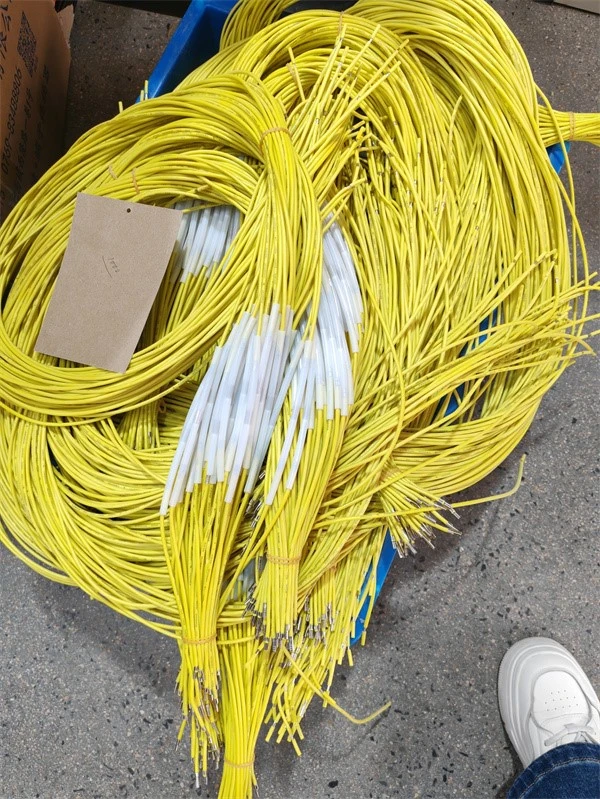
9. Rigid vs Flexible PTFE Tubing for Medical Devices
Medical devices often require small dimensions, controlled tolerances and specific flexibility.
WITFLON's medical PTFE range includes:
● Precision PTFE catheter tubing
● Multi-lumen PTFE tubing
● Etched PTFE liners
● Thin-wall PTFE liners
● PTFE heat-shrink tubing
● Zebra heat-shrink tubing
● Guidewire-related PTFE products
The company's medical tubing is produced in controlled manufacturing environments and the company lists ISO 13485 among its certifications.

Rigid or semi-rigid PTFE
Can be useful for:
● Structural liners
● Stable internal passages
● Components requiring dimensional stability
Flexible PTFE
Can be useful for:
● Catheter liners
● Thin-wall components
● Guidewire systems
● Components routed through compact assemblies
Medical tubing should be selected according to the device design rather than simply requesting "flexible PTFE."
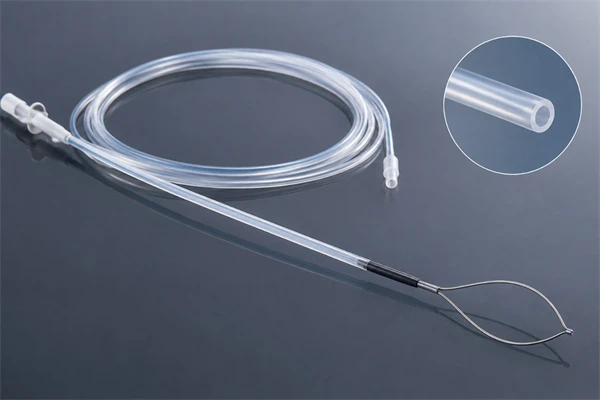
10. Rigid vs Flexible PTFE Tubing for Semiconductor Equipment
Semiconductor equipment places strong requirements on chemical compatibility, cleanliness and dimensional control.
PTFE tubing is used for:
● Chemical delivery
● High-purity fluid transfer
● Equipment connections
● Process equipment
● Chemical handling
Rigid tubing can be useful where the route is fixed and mechanical support is available.
Flexible tubing is more useful around equipment connections where the tube needs to accommodate installation movement or limited space.
WITFLON identifies semiconductor manufacturing as one of the applications for its PTFE tubing products, particularly where chemical resistance and low contamination characteristics are required.
11. Rigid vs Flexible PTFE Tubing for Chemical Processing
Chemical processing systems may require both constructions.
Rigid PTFE Tubing
More suitable for:
● Fixed chemical lines
● Straight routing
● Supported piping
● Thick-wall chemical tubing
● Equipment liners
Flexible PTFE Tubing
More suitable for:
● Pump connections
● Sampling lines
● Compact equipment
● Flexible connections
● Moving assemblies
The chemical resistance comes primarily from the PTFE material.
The rigid/flexible decision is mainly a mechanical and installation decision.
WITFLON's PTFE tubing FAQ lists acid transfer, solvent handling, corrosive liquid transportation and laboratory equipment among typical PTFE applications.
12. Rigid vs Flexible PTFE Tubing for Electrical Insulation
Electrical insulation is another application where rigid and flexible PTFE tubing can serve different purposes.
PTFE has:
● High dielectric strength
● Low moisture absorption
● Stable electrical performance
● High-temperature resistance
● Chemical resistance
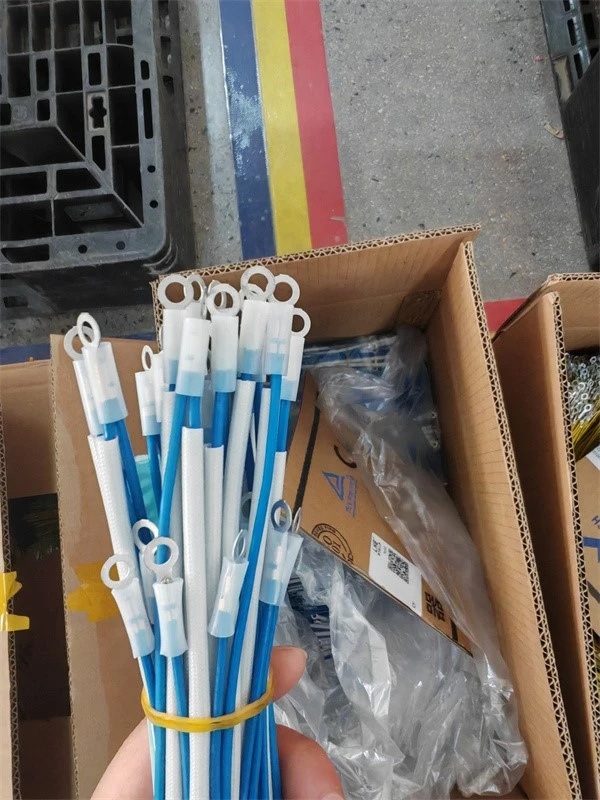
WITFLON supplies PTFE tubing for wire protection, cable insulation, sensor protection and electrical assemblies.
Rigid PTFE
Useful when:
● The tube needs to maintain a defined position
● The cable assembly is relatively fixed
● Mechanical protection is required
Flexible PTFE
Useful when:
● Wires need to bend
● The cable route changes direction
● The assembly has moving sections
● Installation space is restricted
For electrical applications, the required voltage rating and insulation properties should also be specified.
13. Rigid vs Flexible PTFE Tubing for Laboratory Equipment
Laboratory systems often use small-diameter PTFE tubing.
WITFLON's PTFE capillary tubing range includes small IDs and thin-wall constructions designed for accurate fluid or gas transfer. The company also offers customized ID, OD, wall thickness and length.
Flexible capillary tubing can be useful where:
● The tubing must be routed around equipment
● Space is limited
● The line needs to be repositioned
● Small flow passages are required
Rigid PTFE tubing can be preferred where:
● The tube must stay in position
● Dimensional stability is important
● The assembly is fixed
14. Rigid vs Flexible PTFE Tubing: Temperature
Temperature affects flexibility.
PTFE becomes mechanically different at different temperatures, so a tube that is relatively rigid at room temperature may behave differently at elevated temperature.
WITFLON gives a typical continuous operating range of approximately -65°C to +260°C for PTFE tubing, while also noting that actual temperature capability depends on tube size, wall thickness, pressure and chemical conditions.
For this reason, flexibility should be evaluated at the actual operating temperature.
For example:
Room-temperature bend requirement ≠ high-temperature bend requirement
If the tubing will move continuously while hot, the manufacturer should evaluate the complete operating condition rather than relying on a room-temperature bend test.

15. Rigid vs Flexible PTFE Tubing: Service Life
Flexibility alone does not determine service life.
A flexible tube may have a shorter service life if it is repeatedly bent beyond its recommended radius.
Important factors include:
● Bend radius
● Number of bending cycles
● Temperature
● Pressure
● Chemical exposure
● Vibration
● Installation method
● External abrasion
WITFLON's FAQ notes that PTFE tube service life depends on temperature, pressure, chemical exposure, mechanical movement, UV exposure and installation environment.
For dynamic applications, the number of movement cycles and actual bending path should be included in the specification.
16. How to Choose Between Rigid and Flexible PTFE Tubing
Start with the installation.
Choose Rigid PTFE Tubing When:
● The tube follows a fixed route
● Straight installation is preferred
● Dimensional stability is important
● A thicker wall is required
● The tube is well supported
● Movement is limited
● Pressure or mechanical strength is a major concern
Choose Flexible PTFE Tubing When:
● The tube must bend around components
● Installation space is limited
● Equipment movement is present
● Vibration needs to be accommodated
● A smaller bend radius is required
● The tubing needs to be routed through a compact assembly
Choose Corrugated or Convoluted PTFE When:
● A small bend radius is required
● The tube will move repeatedly
● Tight routing is unavoidable
● Flexibility is more important than a completely smooth external structure
Choose Braided PTFE Hose When:
● Flexibility and mechanical reinforcement are both required
● Pressure is higher
● Vibration is present
● The connection is between moving equipment
● A reinforced hose assembly is required
WITFLON offers all of these structural directions, including standard, thin-wall, corrugated, convoluted and braided PTFE tubing.


17. WITFLON Rigid and Flexible PTFE Tubing Options
WITFLON's product range can cover different flexibility requirements without changing away from PTFE.
| WITFLON Product Structure | Flexibility | Typical Purpose |
|---|---|---|
| Rigid PTFE Tube | Low | Chemical and industrial applications |
| Standard PTFE Tube | Low to medium | General fluid transfer |
| Thick-Wall PTFE Tube | Low | Pressure and mechanical strength |
| Thin-Wall PTFE Tube | Medium to high | Compact assemblies and liners |
| PTFE Capillary Tube | High depending on size | Micro-fluid and laboratory systems |
| Corrugated PTFE Tube | High | Tight routing and movement |
| Convoluted PTFE Hose | High | Small bend radius |
| Braided PTFE Hose | Medium to high | Pressure + flexibility |
| Heat Shrink PTFE Tube | Flexible during installation | Protection and insulation |
| Multi-Lumen PTFE Tube | Structure-dependent | Medical and specialized systems |
WITFLON's custom tubing service allows the buyer to define dimensions and structures including single lumen, multi-lumen, corrugated, convoluted, spiral, heat shrink and braided configurations.
18. Custom Rigid or Flexible PTFE Tubing
A standard catalogue size is not always suitable for equipment integration.
WITFLON supports custom PTFE tubing based on customer drawings and technical specifications.
Customization can include:
● Inner diameter
● Outer diameter
● Wall thickness
● Length
● Dimensional tolerance
● Material grade
● Color
● Surface finish
● Bore structure
● Multi-lumen structure
● Corrugated structure
● Convoluted structure
● Heat-shrink structure
● Braided structure
The company's custom PTFE tubing page also supports OEM/ODM projects, small-batch trial production and volume production.
For a flexible tubing project, the drawing should include the required bend radius where possible.
For a rigid tubing project, the drawing should define critical dimensions, support points and connection dimensions.
19. What Information Should You Provide for a PTFE Tubing RFQ?
A request for quotation should include more than "rigid PTFE tube" or "flexible PTFE tube."
| Requirement | Why It Matters |
|---|---|
| ID | Determines flow path |
| OD | Determines installation clearance |
| Wall Thickness | Affects rigidity, pressure and flexibility |
| Length | Determines production and packaging |
| Material Grade | Affects chemical and mechanical performance |
| Temperature | Determines working conditions |
| Pressure | Determines wall and structure |
| Fluid | Determines chemical compatibility |
| Bend Radius | Defines flexibility requirement |
| Movement | Determines dynamic requirements |
| Quantity | Determines production method |
| Tolerance | Determines dimensional control |
| Drawing | Defines the finished structure |
| Certification | Defines material and quality requirements |
For a custom flexible tube, also provide:
Minimum bend radius + movement frequency + operating temperature + pressure
For a rigid tube, provide:
Support method + pressure + wall thickness + dimensional tolerance
WITFLON's custom tubing page specifically recommends providing dimensions, material, quantity, application, temperature, pressure, fluid and drawings where available.
Rigid vs Flexible PTFE Tubing: Final Selection
Rigid and flexible PTFE tubing are not simply two grades of the same product.
The difference comes from the tube dimensions and construction.
A rigid PTFE tube is generally better when the tube needs to hold its shape, maintain stable dimensions or provide a thicker wall for mechanical requirements.
A flexible PTFE tube is more appropriate when the installation contains bends, limited space, movement or vibration.
If flexibility is required without giving up a smooth bore, thin-wall PTFE tubing may be the right direction.
If a much smaller bend radius is required, corrugated or convoluted PTFE tubing can meet this need while retaining the full chemical and temperature performance of PTFE.