

Single-Lumen vs Multi-Lumen PTFE Tubing
The number of lumens inside a PTFE tube changes how the tube is used, installed, and manufactured.
A single-lumen PTFE tube has one continuous internal passage. It is usually selected when one fluid, gas, wire, or component needs to pass through the tube.
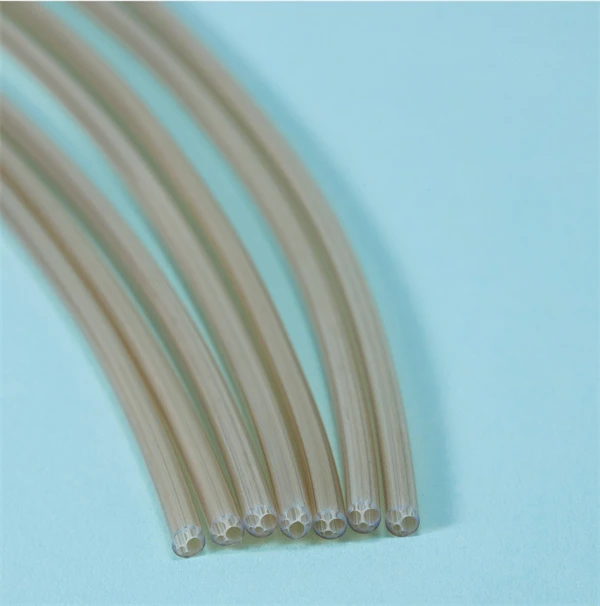
A multi-lumen PTFE tube combines two or more independent passages inside one outer tube. Different lumens can carry different fluids, gases, guidewires, signals, or instruments without requiring several separate tubes.
WITFLON manufactures both standard single-lumen PTFE tubing and customized multi-lumen tubing. Its custom PTFE tubing program allows the customer to specify lumen quantity, lumen dimensions, lumen position, wall thickness, overall diameter, length, tolerance, and cross-sectional design. Existing medical products include 2-lumen, 3-lumen, 8-lumen, and 12-lumen configurations.
The choice between the two is therefore mainly a system design decision, not simply a tubing-size decision.


Single-Lumen vs Multi-Lumen PTFE Tubing: Quick Comparison
| Feature | Single-Lumen PTFE Tubing | Multi-Lumen PTFE Tubing |
|---|---|---|
| Internal passages | 1 | 2 or more |
| Main purpose | One fluid, gas, wire, or component | Multiple independent functions |
| Internal structure | Simple | More complex |
| Fluid pathways | One | Multiple separated pathways |
| Space efficiency | Good | Higher when several functions share one tube |
| Manufacturing | Relatively simple | More demanding |
| Dimensional control | Straightforward | Requires control of each lumen |
| Cleaning | Generally easier | Depends on lumen size and geometry |
| Flow management | One passage | Independent flow paths |
| Wire / guidewire routing | One pathway | Multiple pathways possible |
| Medical devices | Catheter liners, protective tubing, fluid paths | Catheters, endoscopic and minimally invasive systems |
| Chemical applications | Fluid transfer, sampling lines | Multiple media or functional channels |
| Customization | ID, OD, wall, length | Lumen count, size, position, wall, OD, length |
| Typical design priority | Simplicity and direct fluid transfer | Multiple functions in one compact tube |
1. What Is Single-Lumen PTFE Tubing?
Single-lumen PTFE tubing has one continuous internal passage running through the tube.
It is the most straightforward PTFE tubing structure.
The internal diameter defines the main flow or clearance path, while the outer diameter and wall thickness determine the mechanical dimensions of the tube.
WITFLON describes single-lumen tubing as the common tube structure and lists applications including:
● Fluid transfer
● Wire protection
● Electrical insulation
● Chemical handling
● Laboratory equipment
For many industrial applications, there is no reason to add additional lumens when only one internal pathway is required.
A single-lumen design can therefore be a practical choice when the system has one clear function.


2. What Is Multi-Lumen PTFE Tubing?
Multi-lumen PTFE tubing contains several independent internal passages inside one outer tube.
Each lumen can have its own:
● Internal diameter
● Position
● Function
● Flow path
● Wall boundary
The lumens remain separated within the tube.
For example, one lumen could be used for a guidewire, another for irrigation fluid, and another for gas or another working medium.
This allows several functions to be integrated into one compact component.
WITFLON's medical multi-lumen tubing is designed according to customer drawings and can be customized in terms of lumen quantity, lumen size, lumen position, tube length, wall thickness, and cross-sectional shape.


3. The Main Difference: One Path vs Several Paths
The simplest way to understand the difference is to look at the cross-section.
Single-Lumen
┌───────────────┐
│ │
│ ○ │
│ │
└───────────────┘
One outer tube contains one internal passage.
Multi-Lumen
┌───────────────┐
│ ○ ○ │
│ ○ │
│ ○ ○ │
└───────────────┘
Several independent passages are formed inside the same outer structure.
The second design is more difficult to manufacture because the position and dimensions of each lumen have to remain within specification.
4. Why Use Multi-Lumen PTFE Tubing?
The main reason is functional integration.
Instead of installing several separate tubes, the designer can combine multiple pathways into one component.
This can help reduce:
● External tube count
● Installation space
● Routing complexity
● Component count
● Assembly work
This is particularly useful in compact medical devices.
WITFLON identifies multi-lumen PTFE tubing for applications such as catheter systems, guidewire passage, irrigation, gas transmission, and instrument control.
For complex devices, the value of multi-lumen tubing is therefore not simply the number of holes inside the tube. It is the ability to assign different functions to those independent channels.
5. Single-Lumen PTFE Tubing: When Simplicity Matters
A single-lumen tube is often the better choice when the system only requires one pathway.
Typical examples include:
Chemical Transfer
One tube carries one chemical medium from one part of the system to another.
Laboratory Equipment
A single fluid or gas needs to move through a controlled PTFE passage.
Wire Protection
The lumen provides insulation and mechanical protection around a wire or cable.
Electrical Insulation
The PTFE tube is used as an insulating sleeve rather than as a multi-channel component.
General Fluid Transfer
A single continuous passage is sufficient for the equipment design.
WITFLON's general PTFE tubing range covers standard, thin-wall, capillary, corrugated, heat-shrink, multi-lumen, and braided structures, allowing the tube structure to be selected according to the application rather than forcing every project into one configuration.
6. Multi-Lumen PTFE Tubing for Medical Devices
Medical devices are one of the clearest applications for multi-lumen PTFE tubing.
A single medical tube may need to perform several functions at the same time.
For example:
● Guidewire passage
● Irrigation
● Drug delivery
● Gas transmission
● Pressure measurement
● Instrument control
● Signal transmission
Separating these functions into independent lumens allows the device designer to control each pathway independently.
WITFLON's medical multi-lumen products are designed for minimally invasive devices, including catheter systems, endoscopic instruments, laparoscopic devices, and other customized medical systems.
7. 2-Lumen vs 3-Lumen vs Higher-Count PTFE Tubing
Multi-lumen does not mean there is one standard configuration.
The number of lumens should be determined by the device architecture.
2-Lumen PTFE Tube
Two independent passages.
Suitable when the device requires two separate functions.
3-Lumen PTFE Tube
Three independent passages.
This allows three fluids, wires, gases, or functions to be separated within one tube.
4–6 Lumens
Used when the device requires several independent pathways while still maintaining a relatively compact external diameter.
8-Lumen PTFE Tube
WITFLON lists 8-lumen production among its multi-lumen capabilities.
12-Lumen PTFE Tube
WITFLON also states that it mass-produces 12-lumen and 8-lumen tubes for customized applications.
The higher the lumen count, the more important the relationship between lumen diameter, wall thickness, overall OD, and tolerance becomes.


8. Lumen Diameter Matters
For multi-lumen tubing, specifying only the outside diameter is not enough.
Each lumen may require a different internal diameter.
| Parameter | Single-Lumen | Multi-Lumen |
|---|---|---|
| Overall OD | Required | Required |
| Main ID | Required | Each lumen ID |
| Wall thickness | Required | Required |
| Lumen position | Not applicable | Required |
| Number of lumens | 1 | Required |
| Wall between lumens | Not applicable | Required |
| Cross-sectional design | Simple | Critical |
| Tolerance | Required | Required for each critical dimension |
WITFLON specifically asks customers to provide the number of lumens, lumen ID, lumen position, cross-section design, wall thickness between lumens, overall OD, and required tolerance for custom multi-lumen projects.
9. Lumen Position Is a Design Parameter
Two multi-lumen tubes can have the same OD and the same number of lumens but still be completely different products.
Consider these two arrangements:
Symmetrical
○
○ ○
○
and:
Offset
○ ○
○
○
The lumen arrangement affects:
● Wall thickness
● Bending behavior
● Flexibility
● Component positioning
● Assembly
● Internal space
● Connection design
For medical devices, lumen position may need to match the position of downstream components.
WITFLON states that lumen arrangement can be designed according to the customer's device structure and assembly requirements.

10. Wall Thickness Between Lumens
This is one of the details that should not be overlooked during multi-lumen design.
The PTFE material between two adjacent lumens forms the internal separation wall.
That wall must be large enough for the required mechanical and dimensional performance while leaving sufficient space for the lumen itself.
If the wall is too thin, dimensional stability and manufacturing control can become difficult.
If the wall is too thick, valuable internal space is lost.
Therefore, multi-lumen design involves balancing:
Lumen ID + Wall Between Lumens + Outer Wall + Overall OD
This is one reason multi-lumen tubing is normally developed from a technical drawing rather than selected from a generic tubing catalog.

11. Space Efficiency
Suppose a device needs three separate fluid or wire pathways.
One solution is to install three individual tubes.
Another is to manufacture one multi-lumen tube.
The multi-lumen structure can reduce the external space occupied by the tubing assembly.
This can be important in:
● Catheter systems
● Endoscopic instruments
● Minimally invasive devices
● Compact analytical equipment
● Small medical assemblies
● Instrument control systems
WITFLON's medical multi-lumen products are specifically intended for compact medical devices where several independent channels need to be integrated into one component.
12. Fluid Separation
A major advantage of multi-lumen tubing is that different media can travel through separate pathways.
For example:
| Lumen | Possible Function |
|---|---|
| Lumen 1 | Guidewire |
| Lumen 2 | Irrigation |
| Lumen 3 | Gas |
| Lumen 4 | Drug delivery |
| Lumen 5 | Pressure / sensing pathway |
The exact function depends on the device.
The important point is that the channels remain independent.
WITFLON's medical etched multi-lumen tubing describes independent sealed lumens for simultaneous transmission of different media such as drugs, contrast agents, and physiological signals.
13. Flow Characteristics
A single-lumen tube has one continuous flow path.
This makes the relationship between:
ID → flow rate → pressure drop
relatively straightforward.
A multi-lumen tube requires the same calculation for each individual channel.
Each lumen may have a different:
● ID
● Length
● Fluid
● Flow rate
● Pressure
● Temperature
Therefore, the designer should not specify a multi-lumen tube simply as:
3-lumen PTFE tube
A better specification identifies what each lumen needs to do.
For example:
Lumen 1: 0.8 mm ID for guidewire
Lumen 2: 1.2 mm ID for irrigation
Lumen 3: 0.6 mm ID for gas
This gives the manufacturer information that can be used for engineering review.
14. Cleaning and Maintenance
Single-lumen tubing generally has a simpler internal geometry.
A single continuous bore is easier to inspect, clean, and flush.
Multi-lumen tubing contains several smaller passages, so cleaning requirements depend heavily on:
● Lumen diameter
● Lumen length
● Internal surface
● Fluid
● Device design
● Sterilization process
For medical applications, these requirements need to be considered during the original design rather than after the tube has been selected.
WITFLON manufactures medical PTFE tubing in controlled production environments and lists ISO 13485 among its certifications, along with IATF 16949, ISO 14001, and ISO 45001.


15. Flexibility and Bending
The number of lumens can affect how a PTFE tube behaves during bending.
A single-lumen tube has a relatively simple wall structure.
A multi-lumen tube contains internal material webs separating the lumens. Their thickness and position influence the overall mechanical behavior.
For a multi-lumen tube used in a catheter or steerable device, the designer may need to consider:
● Overall OD
● Lumen arrangement
● Wall thickness
● Bend radius
● Tube length
● Material grade
● Required flexibility
The final tube geometry should therefore be tested in the actual device rather than judging flexibility from lumen count alone.
16. Single-Lumen vs Multi-Lumen for Catheter Liners
Catheter design is one of the areas where the difference becomes very clear.
Single-Lumen Catheter
A single central passage can be used for:
● Guidewire
● Fluid delivery
● Suction
● Instrument passage
It provides a relatively simple internal structure.
Multi-Lumen Catheter
Several passages can be incorporated into the same catheter.
For example:
● Guidewire channel
● Irrigation channel
● Drug delivery channel
● Pressure sensing channel
This makes it possible to combine several functions without increasing the number of external tubes.
WITFLON's medical product range includes customized multi-lumen tubes and ultra-thin-wall PTFE liner products for catheter and minimally invasive device applications.
17. Ultra-Thin Wall and Multi-Lumen Design
Wall thickness becomes especially important when the overall tube diameter needs to remain small.
Reducing the outer wall thickness can leave more available space for the internal lumens.
However, there is a limit.
The tube still needs sufficient wall thickness to meet:
● Mechanical requirements
● Pressure requirements
● Dimensional tolerance
● Manufacturing requirements
● Assembly requirements
This is why medical multi-lumen tubing often requires precision extrusion and close dimensional control.
WITFLON's medical multi-lumen products are customized according to drawings and can be produced with reported dimensional tolerances of approximately ±0.03–±0.05 mm for the applicable product range.
18. Single-Lumen vs Multi-Lumen PTFE Tubing for Chemical Applications
Single-lumen PTFE tubing is often sufficient for chemical transfer.
Its smooth, chemically resistant internal passage can be used for:
● Acid transfer
● Solvent transfer
● Sampling
● Laboratory systems
● Chemical dosing
● Corrosive media
Multi-lumen tubing becomes useful when the equipment requires several independent pathways in a limited space.
However, each lumen should be evaluated separately for:
● Chemical compatibility
● Temperature
● Pressure
● Flow
● Cleaning
PTFE itself provides excellent chemical resistance, but the correct tube structure still depends on the actual service conditions.


19. Manufacturing Difficulty
Single-lumen tubing is simpler to manufacture because the extrusion process only needs to maintain one internal passage.
Multi-lumen tubing requires control of several dimensions simultaneously.
Important manufacturing parameters include:
● Lumen diameter
● Lumen position
● Lumen spacing
● Wall thickness
● Overall OD
● Concentricity
● Length
● Cross-sectional geometry
A small dimensional change in one lumen can affect the position of other lumens.
For this reason, a good multi-lumen supplier needs suitable extrusion tooling, process control, dimensional inspection, and experience with customized profiles.
WITFLON reports more than 45 extrusion pipeline production lines and 12 medical-grade pipe production workshops, supporting both small-batch custom development and large-scale mass production for complex multi-lumen PTFE tubing projects.


