

PTFE vs Silicone for Medical Tubing
PTFE and silicone are both widely used in medical tubing, but they solve different design problems.
Silicone is known for its softness, elasticity and flexibility. It is often selected when a medical tube needs to bend easily, conform to a component or maintain flexibility during repeated handling.
PTFE takes a different approach. Its main advantages are low friction, chemical resistance, dimensional stability and a smooth internal surface. These characteristics make PTFE particularly useful as a catheter liner, guidewire pathway, multi-lumen component, heat-shrink tube or precision medical tube.
WITFLON focuses on medical-grade PTFE tubing rather than silicone tubing. Its current medical range includes ultra-thin PTFE liners, precision catheter tubing, multi-lumen PTFE tubes, etched PTFE liners, PTFE heat-shrink tubing and guidewire-related products. The company operates under ISO 13485 and has a 2,000 m² cleanroom production environment.
For medical OEM projects, the better question is not simply "Is PTFE better than silicone?"
It is:
Which material provides the required combination of friction, flexibility, chemical resistance, wall thickness, dimensional control and medical-device performance?

PTFE vs Silicone: Quick Comparison
| Property | PTFE Tubing | Silicone Tubing |
|---|---|---|
| Flexibility | Good, depending on wall thickness and structure | Excellent |
| Elasticity | Low | High |
| Chemical resistance | Excellent | Good to excellent, depending on formulation |
| Friction | Very low | Higher than PTFE |
| Inner surface | Very smooth | Smooth |
| Dimensional stability | Excellent | Lower due to elasticity |
| Compression resistance | Good | Moderate |
| Kink resistance | Depends on structure | Generally good |
| Transparency | Usually translucent/opaque | Often transparent or translucent |
| Temperature resistance | Excellent | Good to excellent, grade dependent |
| Thin-wall capability | Excellent | Good |
| Ultra-thin liner applications | Excellent | Less common for low-friction liners |
| Guidewire movement | Excellent | Less suitable where very low friction is required |
| Catheter liner | Excellent | Application dependent |
| Multi-lumen precision tubing | Excellent | Possible, but different processing characteristics |
| Chemical / contrast media resistance | Excellent | Depends on formulation |
| Heat shrink applications | Available | Limited compared with PTFE heat-shrink designs |
| Medical device use | Catheters, liners, guidewire systems, minimally invasive devices | Drainage, fluid delivery, respiratory and flexible medical tubing |
| WITFLON focus | Medical PTFE tubing | Not a WITFLON product category |
The table is a material-selection guide rather than a universal performance rating. Silicone performance varies significantly with formulation, curing system, hardness and medical grade.
1. Why PTFE Is Used in Medical Tubing
PTFE is particularly useful when the inside of the tube needs to be extremely smooth and low-friction.
WITFLON identifies several medical applications for PTFE tubing, including:
• Catheter liners
• Guidewire coating
• Multi-lumen medical tubes
• Heat-shrink tubing
• Precision catheter tubing
• Minimally invasive medical devices
Its medical PTFE products are made for applications where dimensional control, low friction and chemical resistance are important.
One of the strongest examples is the ultra-thin PTFE liner.
WITFLON's ultra-thin PTFE liner can have a wall thickness as low as 0.03 mm. The liner is designed to preserve internal space while maintaining a compact catheter outside diameter.
This is very different from using a flexible silicone tube as a general fluid hose.

2. Silicone's Main Advantage: Flexibility
Silicone is naturally soft and elastic.
This makes it useful when the medical tube needs to:
• Bend repeatedly
• Follow a curved body or device
• Compress and recover
• Be handled by medical staff
• Fit over a connector
• Maintain flexibility during use
Silicone is commonly considered when softness and compliance are more important than extremely low friction or tight dimensional control.
For example, a medical fluid-delivery tube that needs to bend around equipment may benefit from silicone's elasticity.
PTFE can also be made flexible, but the result depends heavily on:
• Wall thickness
• Tube diameter
• Length
• PTFE grade
• Structure
• Corrugation
• Reinforcement
WITFLON's own PTFE tubing FAQ points out that PTFE flexibility depends on tube diameter, wall thickness, length, temperature and structure.
Therefore, a thin-wall PTFE liner and a heavy-wall PTFE tube should never be treated as having the same flexibility.


3. PTFE Has a Major Advantage in Friction
For catheter and guidewire applications, friction can be more important than softness.
A guidewire or another medical component may need to move through the tube repeatedly.
PTFE has a naturally low-friction surface.
WITFLON's medical PTFE liner is specifically described as having a smooth inner surface and low friction performance. The company uses this characteristic for microcatheters, endoscopic devices, delivery systems and other minimally invasive medical applications.
This can be important when the tube functions as an inner liner, rather than as the outer medical hose.
Example
Consider a catheter with a guidewire running through its internal passage.
The design engineer may need:
Low friction + small OD + maximum internal lumen
An ultra-thin PTFE liner can address these requirements simultaneously.
Silicone may provide excellent flexibility, but if the primary design problem is minimizing sliding resistance, PTFE is often the material that deserves evaluation first.
4. PTFE Is Well Suited to Ultra-Thin Liners
Wall thickness becomes critical when a catheter needs to remain small.
Suppose the outside diameter of the catheter is fixed.
Every additional fraction of a millimeter in liner thickness reduces the available internal lumen.
This affects:
• Guidewire clearance
• Fluid flow
• Instrument passage
• Contrast-media delivery
• Device size
• Catheter flexibility
WITFLON's ultra-thin PTFE liner is specifically designed to maximize internal space while maintaining a compact catheter profile. The website states that wall thickness can be as low as 0.03 mm.
This is one of the strongest reasons to consider PTFE for precision medical tubing.
PTFE liner design
Outer diameter fixed
↓
Reduce liner wall thickness
↓
Increase available internal lumen
↓
Maintain low-friction internal surface
This approach is especially relevant to microcatheters and minimally invasive devices.
5. Silicone Is Better When Elasticity Is the Main Requirement
Silicone's elastic behavior is useful in medical applications where the tube needs to deform during use.
Typical requirements may include:
• Repeated bending
• Compression
• Stretching
• Soft contact
• Flexible routing
• Easy assembly over fittings
PTFE does not behave like an elastomer.
It has much lower elasticity and generally retains its dimensional form rather than stretching and recovering like silicone.
That means a medical designer should not replace silicone with PTFE simply because PTFE has better chemical resistance.
If the tube must behave like a soft, elastic hose, silicone may remain the more practical material.

6. Chemical Resistance: PTFE Has a Strong Advantage
Medical tubing can encounter:
• Saline
• Contrast media
• Cleaning chemicals
• Disinfectants
• Pharmaceutical solutions
• Bodily fluids
• Solvents
• Sterilization chemicals
PTFE is highly resistant to a wide range of chemicals.
WITFLON describes PTFE as resistant to acids, alkalis, solvents, oils and chemical gases. Its medical PTFE products are also described as resistant to medical fluids and contrast media.
Silicone has good chemical resistance, but its behavior depends much more on the formulation and the specific chemical.
For a medical device exposed to aggressive reagents or a combination of chemicals and elevated temperature, PTFE should be evaluated carefully.
The correct comparison should always use the actual chemical + concentration + temperature + exposure time.
7. Temperature Resistance
Temperature is another area where PTFE has an advantage in many applications.
WITFLON lists PTFE medical tubing with a broad operating range and its general PTFE tubing information gives approximately -65°C to +260°C as a typical continuous range, with actual limits depending on dimensions, pressure and application conditions.
Silicone also performs well across a broad temperature range, but the exact limits depend heavily on the silicone formulation and medical grade.
For medical device design, temperature should be considered together with:
• Sterilization method
• Steam exposure
• Chemical exposure
• Pressure
• Repeated thermal cycling
• Wall thickness
A material that survives one sterilization cycle may behave differently after hundreds of cycles.
Therefore, the actual sterilization process should be included in the tubing specification.

8. PTFE for Catheter Liners
This is one of the most important WITFLON applications.
The company manufactures ultra-thin PTFE liners for:
• Microcatheters
• Interventional catheter systems
• Endoscopic devices
• Urological instruments
• Delivery systems
• Medical device assemblies
The liner provides a smooth pathway for guidewires or other components while adding very little wall thickness.
Why use a PTFE liner?
A catheter designer may need:
Small outside diameter
• Large internal lumen
• Low friction
• Chemical resistance
PTFE fits this combination well.
Silicone can be flexible and soft, but it is generally not selected simply to create an ultra-low-friction precision liner.
9. PTFE for Multi-Lumen Medical Tubing
PTFE is also useful when several functions need to be integrated into one small tube.
WITFLON produces custom medical PTFE multi-lumen tubing.
The number, size and position of the lumens can be customized according to the device design. The company's current products include 2-lumen, 3-lumen and multiple-lumen configurations.
Different lumens can be assigned to different functions:
• Guidewire passage
• Irrigation
• Fluid delivery
• Gas transmission
• Instrument control
WITFLON's custom medical multi-lumen tubing is manufactured according to customer drawings, with customization covering lumen quantity, ID, OD, wall thickness, length and cross-sectional design.
This is an area where precision extrusion matters more than simply choosing a "soft" or "hard" material.
10. Dimensional Stability
Medical devices often contain very small clearances.
A tube's dimensions affect:
• Connector fit
• Catheter assembly
• Guidewire clearance
• Flow passage
• Bonding
• Heat shrinking
• Multi-lumen alignment
PTFE has relatively stable dimensions compared with an elastic silicone tube.
Silicone's flexibility is useful, but that flexibility also means its dimensions can change under:
• Compression
• Stretching
• Bending
• Pressure
• Temperature
For a precision catheter liner, this can be an important consideration.
WITFLON's medical PTFE production emphasizes dimensional control. Its ultra-thin liner page specifically describes precision extrusion, wall-thickness consistency and inspection of OD, ID and wall thickness.
11. Transparency: Silicone Has an Advantage in Some Designs
Silicone medical tubing is commonly available in transparent or translucent forms.
This can allow operators to see:
• Fluid movement
• Air bubbles
• Fluid color
• Blockages
• Contamination
PTFE is generally less transparent.
WITFLON's medical PTFE products are therefore better suited to applications where low friction, chemical resistance and dimensional control matter more than direct visual inspection.
If visual monitoring is a primary requirement, the medical device designer should evaluate transparent silicone, FEP or PFA alongside PTFE.
WITFLON itself manufactures FEP and PFA tubing in addition to PTFE, giving OEM customers another fluoropolymer option when transparency is required.
12. Bonding PTFE to Other Materials
One difficulty with PTFE is its low surface energy.
This is excellent for low friction and non-stick performance, but it can make bonding PTFE to another material difficult.
This is where etched PTFE liners become useful.
WITFLON offers etched PTFE liners for medical applications. Surface treatment is used to improve the bonding conditions between PTFE and other materials.
This can be important when the PTFE liner must be incorporated into a larger catheter structure.
The design may therefore use:
PTFE liner → surface treatment → bonding layer → outer catheter structure
rather than simply placing untreated PTFE inside another polymer.
13. Heat-Shrink PTFE for Medical Assemblies
WITFLON also manufactures PTFE heat-shrink tubing for medical applications.
Heat-shrink structures can be used to:
• Cover components
• Secure assemblies
• Protect guidewires
• Join components
• Create controlled outer layers
The medical PTFE range includes zebra/spiral heat-shrink products as well as other heat-shrink structures.
This gives PTFE another role beyond fluid transfer.
A medical device manufacturer may use several PTFE products within one assembly:
PTFE liner + multi-lumen tube + heat-shrink tubing
depending on the device architecture.
14. PTFE vs Silicone for Medical Fluid Transfer
For a simple medical fluid tube, silicone can be an excellent choice when flexibility and softness are the main requirements.
PTFE becomes more attractive when the fluid path requires:
• Low friction
• High chemical resistance
• Higher temperature capability
• Stable dimensions
• Thin walls
• Compact internal passages
Example: Flexible drainage tube
If the tube needs to bend easily and remain soft:
Silicone may be the better starting point.
Example: Catheter guidewire liner
If the tube needs very low friction and minimal wall thickness:
PTFE is usually the material worth evaluating first.
Example: Chemical-resistant medical component
If the device is exposed to aggressive chemicals:
PTFE has a strong advantage.
Example: Multi-lumen precision catheter
If several small channels need controlled positions and dimensions:
Custom PTFE multi-lumen tubing is worth evaluating.
15. PTFE vs Silicone for Sterilization
Sterilization should be included in the material-selection process from the beginning.
Possible methods include:
• Steam sterilization
• EtO
• Gamma radiation
• E-beam
• Other validated sterilization processes
The relevant question is not simply:
"Can PTFE or silicone be sterilized?"
Both materials can be used in medical products that undergo sterilization, but the exact material grade, device construction and sterilization cycle must be validated.
For a medical tubing project, provide:
• Sterilization method
• Temperature
• Exposure time
• Number of cycles
• Radiation dose, if applicable
• Chemical sterilant, if applicable
This allows the tubing manufacturer to evaluate the material and construction properly.
16. PTFE vs Silicone for Catheter Design
For catheter manufacturers, the decision often comes down to the function of the tubing.
| Catheter Requirement | PTFE | Silicone |
|---|---|---|
| Low-friction liner | Excellent | Moderate |
| Very thin liner | Excellent | Application dependent |
| Soft external tube | Limited | Excellent |
| Elasticity | Low | Excellent |
| Guidewire movement | Excellent | Moderate |
| Chemical resistance | Excellent | Good to excellent |
| Dimensional stability | Excellent | Moderate |
| Complex multi-lumen precision | Excellent | Possible |
| Transparent tube | Limited | Excellent |
| Heat-shrink component | Excellent | Limited |
| High-temperature exposure | Excellent | Application dependent |
| Flexible body-contact tube | Moderate | Excellent |
This is why medical devices frequently use more than one polymer.
A catheter may use silicone for the outer flexible structure while using PTFE as an inner liner.
The two materials do not always compete for the same position in the device.

17. PTFE + Silicone Can Be Used in the Same Medical Device
A common engineering approach is to assign each material a specific job.
For example:
Outer Layer
Silicone
• Soft
• Flexible
• Elastic
• Comfortable handling
Inner Liner
PTFE
• Low friction
• Smooth surface
• Chemical resistance
• Guidewire compatibility
This combination can provide different properties at different locations within the same device.
WITFLON's etched PTFE liner capability is relevant to this type of construction because surface treatment can improve the conditions for bonding PTFE with other materials.
For OEM development, the liner should therefore be evaluated as a component of the complete catheter, rather than as an independent tube.
18. Medical Grade and Manufacturing Environment Matter
For medical tubing, the polymer name alone is not enough.
Two PTFE tubes can have different suitability for a medical application depending on:
• Resin grade
• Processing conditions
• Cleanliness
• Dimensional control
• Inspection
• Packaging
• Traceability
• Biocompatibility documentation
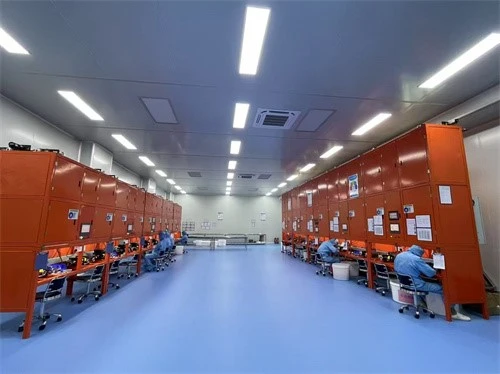
WITFLON operates under ISO 13485 and has a 2,000 m² cleanroom within its more than 10,000 m² production facilities. The company also lists IATF 16949, ISO 14001 and ISO 45001 certifications. Its medical tubing products are described as using medical-grade or high-purity PTFE materials, with biocompatibility testing for medical PTFE products.
For an OEM medical project, ask for the documentation applicable to the exact tubing being purchased rather than relying on a general company certificate.


19. What Medical OEM Buyers Should Specify
A medical tubing RFQ should contain more information than:
"Please quote medical PTFE tube."
Provide the following.
Tube Dimensions
• ID
• OD
• Wall thickness
• Length
• Tolerance
• Roundness
Material
• PTFE or silicone
• Medical grade
• Resin/formulation
• Color
• Transparency
Device Function
• Catheter liner
• Fluid transfer
• Guidewire pathway
• Multi-lumen tube
• Heat-shrink component
• Protective sleeve
Operating Conditions
• Fluid
• Pressure
• Temperature
• Bending
• Mechanical movement
Sterilization
• EtO
• Steam
• Gamma
• E-beam
• Number of cycles
Assembly
• Bonding
• Heat shrinking
• Overmolding
• Mechanical fitting
• Etching requirement
Quality
• Biocompatibility requirement
• Cleanliness
• Dimensional inspection
• Lot traceability
• Packaging
• Regulatory documentation
WITFLON's custom tubing process specifically recommends providing ID, OD, wall thickness, length, material, quantity and application. For medical projects, it also recommends specifying certification, cleanliness and regulatory requirements.
20. WITFLON Medical PTFE Tubing Capabilities
WITFLON's medical PTFE range is more specialized than a general-purpose fluoropolymer tube catalog.
Current medical products include:
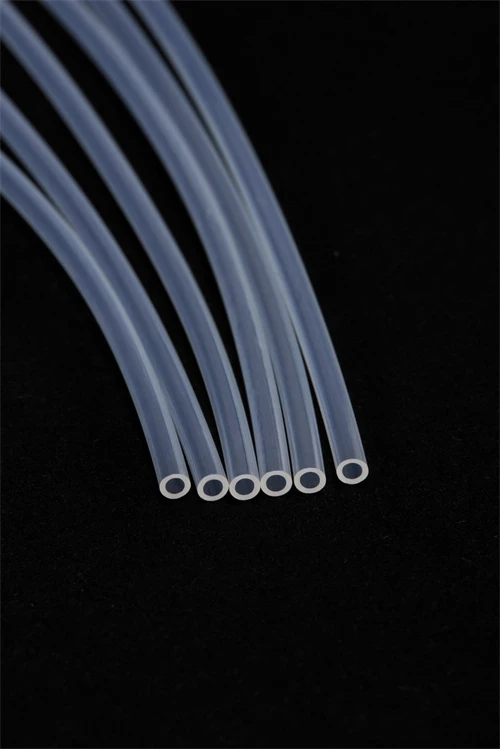
• Ultra-thin PTFE liner tubing
• Precision PTFE catheter tubing
• Medical custom PTFE multi-lumen tubing
• Etched PTFE liners
• PTFE heat-shrink tubing
• PTFE guidewire-related products
• PTFE coated guide wire
The company's manufacturing resources include more than 45 extrusion pipeline production lines, 24 medical-grade pipe production machines, CNC equipment and other processing equipment.
For custom medical projects, WITFLON supports:
• Custom ID
• Custom OD
• Custom wall thickness
• Custom length
• Multi-lumen structures
• Custom cross-sections
• Etched surfaces
• Heat-shrink structures
• OEM production
• Small-batch trials
• Volume production
Its custom medical multi-lumen products can be designed around customer drawings and specifications, including lumen quantity, lumen size, position, wall thickness, length and cross-sectional geometry.




PTFE vs Silicone for Medical Tubing: Which Should You Choose?
The selection becomes much easier when the tube's actual job is defined.
Choose PTFE when the medical device requires:
• Very low internal friction
• Ultra-thin liner construction
• Excellent chemical and contrast media resistance
• Stable dimensional control
• Precision multi-lumen geometry
• High-temperature or aggressive sterilization cycles
• Guidewire movement through a compact catheter
• Heat-shrink medical assembly components
Choose silicone when the medical device requires:
• High elasticity and soft body contact
• Repeated bending and flexible routing
• Transparent fluid visual inspection
• Easy manual handling and connector assembly
• Long-term body surface or tissue contact
• Simple, low-cost flexible fluid delivery
In many modern medical devices, the optimal design is not "PTFE or silicone" - it is a targeted combination: silicone for the soft outer body, and PTFE for the precision low-friction internal liner. This way each material performs the task it does best, without forcing one polymer to solve all the design problems at once.