

PTFE Tubing for Heat Exchanger Systems: Where It Fits and What to Check
Heat exchangers move heat between two fluids without letting them mix. In chemical processing, lab equipment, and industrial heating or cooling systems, the tubing material quietly decides how stable that heat transfer stays over time.
When the process fluid is corrosive, high-purity, or running at demanding temperatures, metal tubing is not always the best answer. PTFE tubing gets considered because it combines broad chemical resistance, thermal stability, and a non-stick surface.
But selecting PTFE tubing for a heat exchanger is not just a temperature-rating check. Tube dimensions, wall thickness, operating pressure, flow rate, and heat-transfer requirements all need to be reviewed together.
This guide covers where PTFE tubing can be used in heat exchanger systems, what affects its performance, and how to specify a tube that matches the application.

Why PTFE Tubing Gets Used in Heat Exchanger Systems
A heat exchanger relies on thermal energy moving between two fluids. Depending on the design, one fluid flows through the tubes while another passes around them. In aggressive chemical service, the tubing has to stay in continuous contact with the process medium without unacceptable corrosion or contamination.
PTFE brings several characteristics worth considering.
Broad chemical resistance
PTFE resists many acids, alkalis, solvents, and other aggressive chemicals. That makes it useful where process fluids could damage conventional metal or plastic tubing.
Typical cases include chemical circulation, corrosive liquid cooling, and industrial process equipment. Actual compatibility still needs to be checked against the chemical composition, concentration, operating temperature, and exposure time.
Thermal stability
PTFE maintains useful properties across a wide temperature range compared with many conventional plastics. It can be a potential material for heat exchanger applications involving temperature fluctuations or elevated-temperature fluids.
But the maximum operating temperature of a finished tube is not set by the resin alone. Tube dimensions, pressure, mechanical loading, fittings, and operating conditions all matter.
Non-stick inner surface
PTFE has a low-friction, non-stick bore that can help reduce material adhesion inside the tube. This is useful when process fluids might otherwise leave deposits on tubing surfaces.
It does not eliminate scaling, crystallization, or blockage. Fluid properties and operating conditions still determine the deposit risk.
Electrical and corrosion insulation
Unlike metallic tubing, PTFE does not conduct electricity and does not undergo conventional metal corrosion. This can help where electrical insulation or isolation between the process fluid and metal components is required.
Common Heat Exchanger Applications for PTFE Tubing
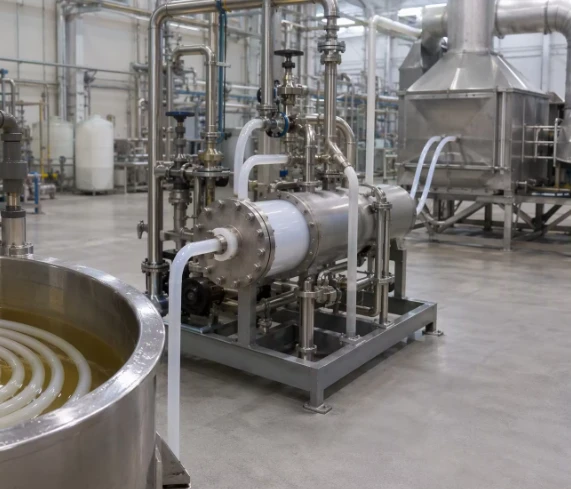
PTFE tubing can be considered in several heat exchanger designs-especially where chemical compatibility matters more than maximizing heat transfer through the tube wall.
Chemical processing heat exchangers
Chemical plants handle acids, alkalis, solvents, and other corrosive liquids. PTFE tubing may be used in heat exchanger assemblies for corrosive fluid circulation, chemical cooling, and temperature control.
The main question is whether the selected tube can withstand the chemical and mechanical conditions for the expected service life.
Industrial cooling systems
Some industrial processes generate heat that must be removed continuously. PTFE tubing may be considered where cooling fluids or process media are chemically aggressive, or where corrosion resistance is important to system reliability.
Laboratory and analytical equipment
Lab heat exchangers often need compact tubing arrangements and controlled fluid delivery. Small-diameter PTFE tubing can be useful where chemical compatibility, clean fluid pathways, and flexible installation are important.
Semiconductor and high-purity processing
Some high-purity manufacturing processes need tubing that helps maintain fluid cleanliness and resist aggressive chemicals. PTFE and other fluoropolymers may be considered.
High-purity requirements should be evaluated separately-material grade, extractables, cleanliness, particle control, and documentation all need review.
How to Select PTFE Tubing for a Heat Exchanger
Choosing the right tube is a balance between chemical resistance, mechanical strength, and heat-transfer performance. Review these factors before confirming a specification.
Operating temperature
Temperature affects both material performance and the mechanical strength of polymer tubing. A PTFE tube used at elevated temperature may have a different allowable working pressure from the same tube at room temperature.
Consider:
Normal operating temperature
Maximum and minimum temperatures
Temperature fluctuations during startup and shutdown
Continuous exposure time
Thermal cycling frequency
Do not select tubing only from the maximum temperature listed for PTFE resin. Evaluate the finished tube under its actual operating conditions.
Operating pressure
The tube wall must withstand the internal pressure of the circulating fluid, including pressure fluctuations during operation. Confirm:
Normal working pressure
Maximum operating pressure
Pressure surges
Vacuum conditions, if applicable
Required service life
Tube diameter and wall thickness directly affect pressure resistance. A larger ID or thinner wall may require a different pressure evaluation. Confirm pressure ratings using the manufacturer's data for the actual tube dimensions and operating temperature.
Inner diameter and outer diameter
The ID sets the available flow passage. The OD affects installation and connection requirements. An unsuitable ID can lead to excessive flow resistance or insufficient flow capacity.
Select dimensions based on:
Required flow rate
Fluid viscosity
Available pressure
Tube length
Heat exchanger configuration
Connection and fitting dimensions
Compact or lab-scale heat exchangers may need smaller-diameter PTFE tubing. Industrial circulation systems may need larger tubing depending on required flow capacity.
Wall thickness
Wall thickness affects both mechanical strength and heat transfer. A thicker wall generally provides more material to resist internal pressure, but it also adds thermal resistance across the tube wall.
A thinner wall may improve heat transfer through the tubing, but it can reduce pressure resistance and mechanical durability. The right wall thickness balances pressure requirements, thermal performance, and expected service conditions.
Chemical compatibility
The process fluid must be compatible with the selected tubing material. PTFE offers broad chemical resistance, but compatibility should not be assumed for every chemical under every condition.
Before selecting a tube, provide:
Chemical name or fluid composition
Concentration
Operating temperature
Operating pressure
Continuous or intermittent exposure
Expected service life
For mixtures or unusual operating conditions, application-specific compatibility verification is recommended.
PTFE vs. PFA vs. FEP Tubing for Heat Exchanger Systems
PTFE, PFA, and FEP are all fluoropolymers, but they process differently and suit different equipment requirements.
| Material | Main characteristics | Potential application considerations |
|---|---|---|
| PTFE | Broad chemical resistance, thermal stability, low friction | Corrosive fluid circulation and flexible tubing arrangements |
| PFA | Excellent chemical resistance, melt-processable, available in high-purity grades | Applications requiring complex fabrication, high purity, or suitable joining methods |
| FEP | Chemical resistance, transparency, melt processability | Applications where fluid visibility and fabrication flexibility are important |
The best material depends on the complete system design, not one property alone.
PTFE may suit where chemical resistance and temperature performance are priorities. PFA may be worth evaluating when transparency, fabrication, or high-purity requirements matter. FEP may be considered for less demanding temperature requirements where visibility is useful.
The final selection should be based on the specific fluid, pressure, temperature, tube dimensions, and fabrication requirements.
How PTFE Tubing Affects Heat Transfer Efficiency
Heat transfer is one of the most important design considerations in a heat exchanger. PTFE offers excellent chemical resistance, but its thermal conductivity is relatively low compared with common metals such as copper and stainless steel.
That means PTFE tubing should not automatically be treated as a direct replacement for metal tubing when maximum heat transfer efficiency is the main objective.
Several design factors influence overall performance.
Tube wall thickness
The tube wall forms part of the thermal resistance between the two fluids. A thinner wall can reduce resistance to heat transfer through the material. But the wall must remain thick enough to meet pressure and mechanical requirements.
Tube surface area
A larger heat transfer surface area can support greater heat exchange, provided flow and temperature conditions are suitable. Tube length, number of tubes, and tube arrangement all influence available surface area.
Fluid flow rate
Flow rate affects heat movement within the system. Too low, and the system may not achieve required thermal performance. Too high, and pressure drop and pumping requirements may increase. The appropriate flow rate depends on fluid properties and heat exchanger design.
Temperature difference
The temperature difference between the two fluids is a major factor in the heat transfer driving force. Establish the required thermal performance before finalizing tubing material and dimensions.
Key point: PTFE tubing is often selected for chemical resistance rather than superior thermal conductivity. Where high heat transfer efficiency is essential, review the complete heat exchanger design to determine whether PTFE, PFA, FEP, or another material is more appropriate.
Custom PTFE Tubing for Heat Exchanger Manufacturers
Standard tubing dimensions may not meet every heat exchanger design requirement. Equipment manufacturers and industrial buyers may need customized tubing to match specific flow paths, connection structures, or installation spaces.
Depending on manufacturing capability, custom PTFE tubing specifications may include:
Customized inner and outer diameters
Different wall thicknesses
Specific tube lengths
Straight or coiled configurations
Natural or customized colors
Special dimensional tolerances
OEM tubing specifications
For projects involving multiple tubing sections or compact equipment, dimensional consistency is especially important. Before production, confirm the tube drawing, dimensional tolerances, material grade, and intended operating conditions
What to Send When Ordering PTFE Heat Exchanger Tubing
To identify a suitable tubing specification, buyers should provide more than the required tube diameter. The following information helps manufacturers evaluate the application.
| Required information | Example or description |
|---|---|
| Material | PTFE, PFA, or FEP |
| Inner diameter | Required ID in mm or inch |
| Outer diameter | Required OD in mm or inch |
| Wall thickness | Calculated or specified wall thickness |
| Tube length | Straight length or coil length |
| Fluid | Chemical name or fluid composition |
| Operating temperature | Normal and maximum temperature |
| Operating pressure | Normal and maximum pressure |
| Flow rate | Required fluid flow |
| Quantity | Prototype, trial order, or mass production |
| Special requirements | Tolerance, cleanliness, color, or OEM specifications |
If the heat exchanger design is still in development, a technical drawing or sample tube can help clarify the required dimensions.
Why Work with a Custom PTFE Tubing Manufacturer?
For heat exchanger manufacturers, tubing quality and dimensional consistency can influence assembly efficiency and long-term equipment performance. Working directly with a tubing manufacturer makes it easier to discuss material selection, dimensions, and customization requirements.
When evaluating a supplier, consider:
- Experience with PTFE and other fluoropolymer tubing
- Available tube sizes and customization capabilities
- Dimensional tolerance control
- Material traceability and quality documentation
- Sample availability for testing
- Ability to support OEM requirements
A suitable manufacturer should be able to review the intended application and confirm whether the requested tubing specification is technically appropriate.
At WITFLON, Hubei Zetai New Material Co., Ltd. supplies PTFE tubing and other fluoropolymer products for industrial and medical applications. Our range includes PTFE tubing, PFA tubing, and FEP tubing, with customization support for OEM projects requiring specific dimensions or configurations.
Request Custom PTFE Tubing for Your Heat Exchanger Project
Looking for PTFE tubing for a heat exchanger system? Whether you need standard tubing, small-diameter PTFE tubing, or a custom fluoropolymer tube for a compact heat exchanger design, send us your requirements and our team will review suitable options.
To help us evaluate your project, please provide:
Application: Heat exchanger type, chemical processing, cooling system, or lab equipment
Fluid: Chemical name or composition and concentration
Operating conditions: Normal and maximum temperature, pressure, and flow rate
Tube dimensions: Required ID × OD, wall thickness, and length
Configuration: Straight or coiled, with tolerances if required
Connection details: Fitting type or technical drawing
Quantity: Sample, trial order, or production demand
Contact WITFLON today for a PTFE tubing quotation. Send your drawing or specification and we'll discuss material selection, dimensional requirements, samples, and production options for your heat exchanger application
Frequently Asked Questions
1. Can PTFE tubing be used in heat exchanger systems?
Yes. PTFE tubing can be used in selected heat exchanger systems, especially where chemical resistance and temperature stability are important. Its relatively low thermal conductivity should also be considered when evaluating heat transfer performance.
2. Is PTFE tubing suitable for high-temperature heat exchangers?
PTFE has good thermal stability, but the allowable operating temperature of a finished tube depends on its dimensions, pressure, mechanical loading, and installation conditions. Always confirm the manufacturer's working limits for the specific tube.
3. Does thinner PTFE tubing improve heat transfer efficiency?
A thinner wall can reduce thermal resistance through the tube wall. However, reducing wall thickness may also reduce pressure resistance and mechanical strength. The final design needs to balance thermal and mechanical requirements.
4. Is PTFE better than PFA for heat exchanger tubing?
Not necessarily. PTFE offers broad chemical resistance and good thermal stability, while PFA provides melt-processability and may be available in high-purity grades. The better choice depends on operating conditions, fabrication requirements, and system design.
5. Can PTFE tubing be customized for industrial heat exchangers?
Yes. Custom PTFE tubing may be produced according to specified inner diameter, outer diameter, wall thickness, and length, subject to manufacturing capabilities. Buyers should provide technical drawings and application details for evaluation.
6. What information is needed to request a PTFE tubing quotation?
Provide the material, ID, OD, wall thickness, length, quantity, fluid type, operating temperature, and pressure. A drawing or sample is helpful when customized dimensions or tolerances are required.