

What Is the Internal Diameter (ID) of PTFE Capillary Tubing?
The internal diameter-ID for short-is the diameter of the open passage inside the tube. It determines how much space is available for liquid to flow.
A complete PTFE capillary tubing specification normally includes three dimensions:
ID (Inner Diameter): the diameter of the internal fluid passage
OD (Outer Diameter): the total diameter measured across the outside of the tube
Wall Thickness: the PTFE material between the inner and outer surfaces
For example, a PTFE capillary tube specified as 1 mm ID × 2 mm OD has a nominal wall thickness of 0.5 mm.
Here's how different internal diameters are typically considered:
| PTFE Tube ID | Typical Consideration |
|---|---|
| 0.5 mm | Very small fluid passages and specialized low-volume applications |
| 0.8 mm | Compact fluid paths requiring a small internal diameter |
| 1.0 mm | Small-volume laboratory fluid delivery |
| 1.5 mm | Applications requiring a larger flow passage |
| 2.0 mm | Higher flow requirements within compatible equipment designs |
These are illustrative examples, not universal application standards. The right ID depends on the fluid, flow rate, pressure, tube length, and equipment design.
For precision applications, confirm the actual ID tolerance-not just the nominal dimension. A "1 mm" tube that varies too much in the bore can behave very differently from one that holds its tolerance.
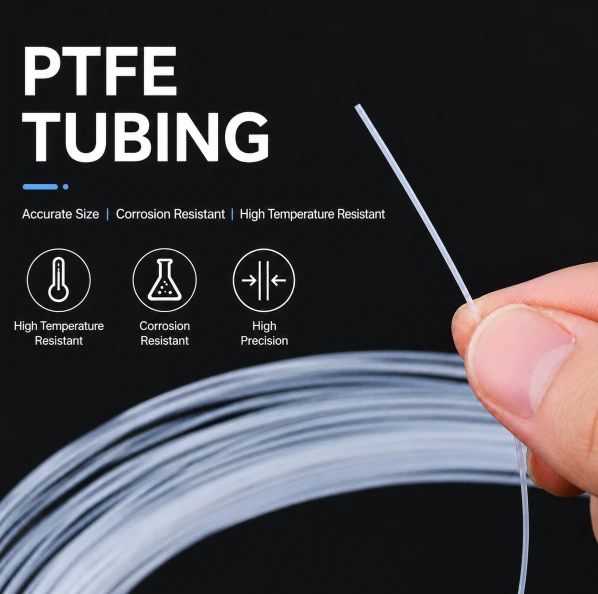
How Does PTFE Capillary Tubing ID Affect Flow Rate?
ID has a major influence on liquid flow through a capillary tube. For steady, laminar flow of a Newtonian liquid through a straight, rigid, circular tube, the relationship follows the Hagen–Poiseuille equation:
Q=πΔPd4128μLQ=128μLπΔPd4
Where:
Q = volumetric flow rate
ΔP = pressure difference between inlet and outlet
d = internal diameter of the tube
μ = dynamic viscosity of the liquid
L = tube length
The key takeaway: flow rate is proportional to the fourth power of the internal diameter when other variables stay constant. That means even a relatively small ID change can produce a big flow change.
Why does a small ID change make such a big difference?
Consider a simplified comparison under identical pressure, fluid viscosity, and tube length.
| Internal Diameter | Relative Theoretical Flow Rate |
|---|---|
| 0.5 mm | 1× |
| 1.0 mm | 16× |
| 1.5 mm | 81× |
| 2.0 mm | 256× |
The 0.5 mm tube is the reference.
These are theoretical ratios calculated from the fourth-power relationship. They are not measured flow rates or guaranteed performance values for commercial PTFE tubing.
Doubling the ID from 0.5 mm to 1.0 mm theoretically increases flow by 16 times under the same idealized conditions. That's why ID selection gets so much attention in controlled liquid delivery systems.
In real equipment, actual performance may differ because of fittings, pump characteristics, entrance losses, temperature changes, fluid behavior, and other system restrictions.
Does a Smaller PTFE Capillary Tube Provide Better Dosing Accuracy?
This is one of the most common questions from buyers of precision dosing equipment. The honest answer: a smaller ID does not automatically mean better dosing accuracy.
A smaller ID increases hydraulic resistance. Under the same pressure, less liquid passes through the tube in a given period. That can be useful for low-flow applications, but it also creates challenges.
Advantages of a smaller internal diameter
1. Lower flow capacity
A smaller ID limits the flow passage and can help achieve lower flow rates under suitable pressure conditions.
2. Smaller internal fluid volume
A smaller tube holds less liquid per unit length, which can help when handling small sample volumes.
3. Compact fluid delivery design
Small-diameter tubing fits compact lab instruments and equipment with limited installation space.
Potential limitations of a smaller internal diameter
1. Higher flow resistance
Smaller IDs need more pressure to maintain the same flow rate.
2. Greater sensitivity to dimensional variation
Because flow resistance depends heavily on ID, small bore variations can shift flow performance.
3. Greater risk of flow restriction
Particles, deposits, air bubbles, or incompatible fittings can create significant restrictions in a narrow passage.
4. Longer response time in some systems
Depending on the pump and control arrangement, high flow resistance may slow how quickly the system reaches target flow.
What actually determines dosing accuracy?
Dosing accuracy comes from the complete fluid delivery system:
- Pump type and control precision
- Pressure stability
- Actual tubing ID and dimensional tolerance
- Fluid viscosity and temperature
- Tubing length
- Air bubbles and trapped liquid
- Valve and fitting design
- System calibration
A dosing system using 0.5 mm ID PTFE capillary tubing may deliver a lower flow rate than one using 1.0 mm ID tubing under the same pressure. But if the pump, pressure control, and calibration are properly matched to each tube, either size can work for its intended application.
The goal is not to pick the smallest possible ID. It is to select a tube that allows the system to deliver the required volume repeatably-within the pressure, response-time, and fluid constraints of the equipment. In many cases, that means balancing flow resistance against pump capability and calibration stability, then verifying the choice through actual testing rather than relying on the nominal size alone.
How to Select the Right PTFE Capillary Tubing ID for Your System
With the theory covered, here's the practical part: how to narrow down the ID for a real dosing system.
Start with the required dispensed volume per cycle
Work backward from what the system must deliver. If each cycle dispenses a small reagent volume, the tube needs to hold and release that volume predictably. Calculate the internal volume per unit length for candidate IDs and compare it with the target dose.
Check the available pressure budget
A smaller ID raises flow resistance. If the pump cannot supply enough pressure, the system may never reach the target flow rate-or response time may become unacceptable. Confirm the pump's pressure capability against the estimated pressure drop at the target flow.
Factor in fluid viscosity and temperature
Water-like reagents, solvents, oils, and concentrated chemical solutions behave very differently in a narrow bore. Higher viscosity generally requires more pressure for the same flow. Temperature changes shift viscosity, so specify the actual operating temperature range rather than a single point.
Account for tube length and routing
Longer tubes increase pressure drop and internal volume. For small-volume dosing, an unnecessarily long line can increase retention and slow response. Keep the fluid path as short and direct as the equipment layout allows, and confirm the final length before production.
Confirm ID tolerance with the supplier
Two tubes with the same nominal ID can perform differently if their bore tolerances differ. For precision dosing, ask for the actual ID tolerance range-not just the nominal size-and confirm how it is inspected.
Match the OD and fittings to the equipment
The ID may be right while the OD doesn't fit the connector. Confirm OD, wall thickness, fitting type, and sealing method together. A poorly matched connection can create dead volume, leakage, or inconsistent delivery.
Test and calibrate the complete system
No tube specification replaces system testing. Build the fluid path, run the actual liquid at the actual operating conditions, and calibrate the pump against measured dispensed volume. If performance drifts, check ID tolerance, air bubbles, fitting condition, and temperature stability before changing the tube size.
Common ID-Related Problems in Precision Dosing
Problem 1: Flow rate lower than expected
A tube ID smaller than the design value-or higher flow resistance from length and fittings-can reduce flow. Check the actual bore, tube length, and pressure at the inlet.
Problem 2: Inconsistent dispensed volume
Variation in ID tolerance, trapped air, or temperature-driven viscosity changes can cause cycle-to-cycle differences. Verify ID tolerance and eliminate bubbles before adjusting the pump.
Problem 3: Slow response after a dosing command
High flow resistance or excessive internal volume can delay response. Review ID, tube length, and pump pressure capability together.
Problem 4: Blockage in narrow tubing
Particles or deposits can restrict a small bore. Specify filtration or cleaning procedures where appropriate, and confirm the minimum practical ID for the fluid.
Custom PTFE Capillary Tubing for Precision Dosing Systems
Standard capillary sizes cover many applications, but precision dosing equipment often needs dimensions matched to a specific pump, connector, or fluid path.
At WITFLON, Hubei Zetai New Material Co., Ltd., we supply PTFE capillary tubing and other fluoropolymer tubing for industrial and medical applications. Our range includes PTFE tubing, PTFE capillary tubing, PFA tubing, and FEP tubing, with customization support for OEM projects.
For ID-sensitive dosing applications, we recommend sharing the target flow rate or dispensed volume, fluid name and viscosity, operating pressure and temperature, required ID × OD, ID tolerance, tube length, and connection details. That lets us review the appropriate specification before production.
Explore our PTFE Capillary Tube range, or review PFA Tube and FEP Tube options if transparency or high-purity fluid handling is part of the project.
Request a PTFE Capillary Tubing Quote for Your Dosing Application
Need help matching PTFE capillary tubing ID to your flow and dosing requirements? Send us your specifications and our team will review suitable options.
To help us evaluate your project, please provide:
Application: Precision dosing, analytical instrument, microfluidic system, or other equipment
Target flow rate or dispensed volume per cycle
Fluid: Chemical name, concentration, and viscosity (if available)
Operating conditions: Working pressure and temperature range
Tube dimensions: Required ID × OD, ID tolerance, and wall thickness
Tube length: Required length per piece or roll
Connection details: Fitting type or technical drawing
Order quantity: Sample and estimated production demand
Contact WITFLON today for a PTFE capillary tubing quotation. Send your drawings or tube specifications to discuss material selection, dimensional tolerance, samples, and production options for your precision fluid delivery system.

Frequently Asked Questions
1. How does PTFE capillary tubing ID affect flow rate?
Under laminar flow, flow rate is proportional to the fourth power of the internal diameter. A small increase in ID can produce a large increase in flow under the same pressure, fluid, and length. Actual performance also depends on fittings, pump behavior, and fluid properties.
2. Is a smaller ID always better for dosing accuracy?
No. A smaller ID increases flow resistance and can improve low-flow control, but it also raises pressure requirements and sensitivity to blockage. Dosing accuracy depends on the pump, pressure stability, ID tolerance, fluid properties, and system calibration.
3. What ID tolerance should I specify for precision dosing?
The required tolerance depends on the target dose, acceptable flow variation, and pump control. For critical applications, specify the ID tolerance range explicitly and confirm how the supplier inspects it, rather than relying on the nominal size.
4. Can I use the Hagen–Poiseuille equation to predict my dosing flow?
It is useful for understanding the strong effect of ID and for initial sizing, but real systems include fittings, entrance effects, pump characteristics, and non-ideal flow. Verify performance through testing and calibration with the actual liquid and equipment.
5. Can WITFLON customize PTFE capillary tubing by ID and tolerance?
Yes. Customized PTFE capillary tubing may be available with special IDs, ODs, wall thicknesses, dimensional tolerances, and cutting lengths. Provide a drawing or sample so we can review production feasibility and confirm the specification.