

Why PTFE Capillary Tubing Gets Used in Precision Dosing
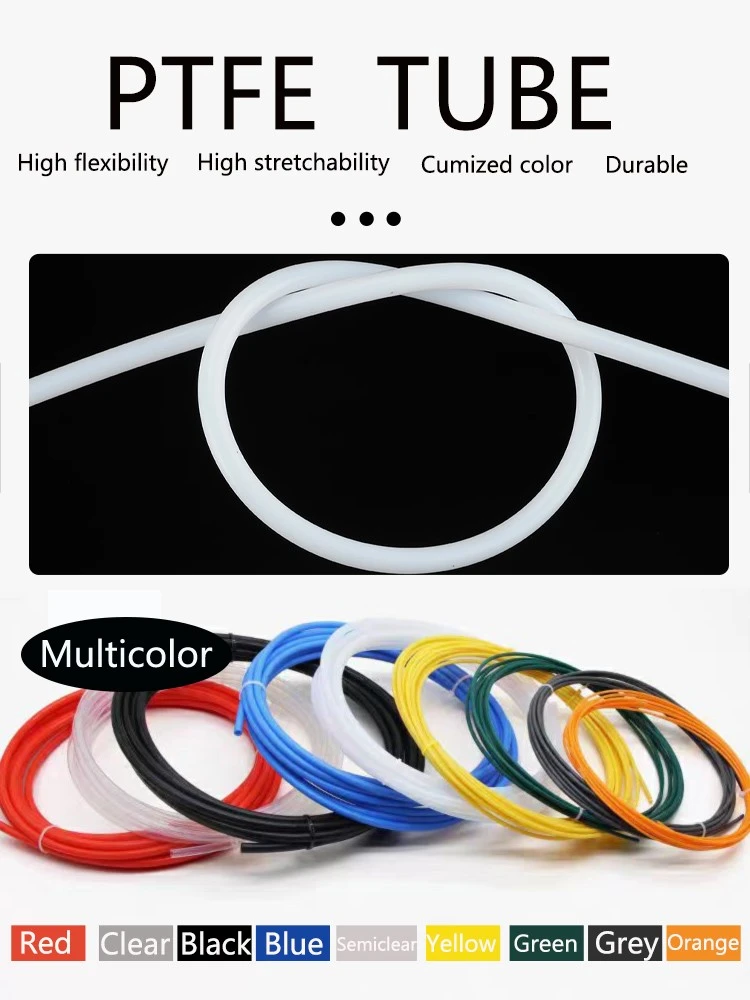
PTFE (polytetrafluoroethylene) is a fluoropolymer used widely in chemical fluid handling. It makes sense for dosing systems where ordinary plastic tubing may not survive the chemical load.
Chemical resistance across different fluids
Precision dosing equipment may handle chemical reagents, laboratory solvents, cleaning solutions, and other liquids. PTFE offers broad resistance to many acids, alkalis, and organic solvents, making it useful where chemical compatibility is a key concern.
Typical applications include:
- Laboratory reagent dispensing
- Chemical dosing equipment
- Analytical instrument fluid paths
- Small-volume chemical transfer
- Automated liquid handling systems
Compatibility still has to be checked against the exact chemical, concentration, temperature, and exposure conditions. "PTFE is resistant" is a starting point, not a final answer.
Small IDs for compact fluid paths
Many precision dosing systems move relatively small liquid volumes. PTFE capillary tubing is available in small internal diameters, so it can connect compact components and narrow delivery channels.
The ID directly affects the available flow passage and hydraulic resistance. Under the same pressure, even a small dimensional change can influence flow. That is why ID selection deserves attention early in the design-especially for low-flow delivery systems.
Low-friction internal surface
PTFE has a naturally low coefficient of friction and a non-stick surface. These properties can help reduce resistance along the tube and limit adhesion of certain substances to the inner wall.
For sensitive liquids, also look at tubing cleanliness, fluid compatibility, and potential sample carryover. A low-friction surface helps, but it does not replace a proper cleaning and compatibility review.
Thermal stability
Some dosing systems handle heated reagents or see temperature changes during production and testing. PTFE maintains useful properties across a broad temperature range, so it can suit many temperature-variable applications.
Temperature also changes the viscosity of many liquids. That can shift flow rate and pressure requirements. Confirm the finished tube's allowable operating conditions against its dimensions and actual service conditions.
Where PTFE Capillary Tubing Is Used in Precision Dosing
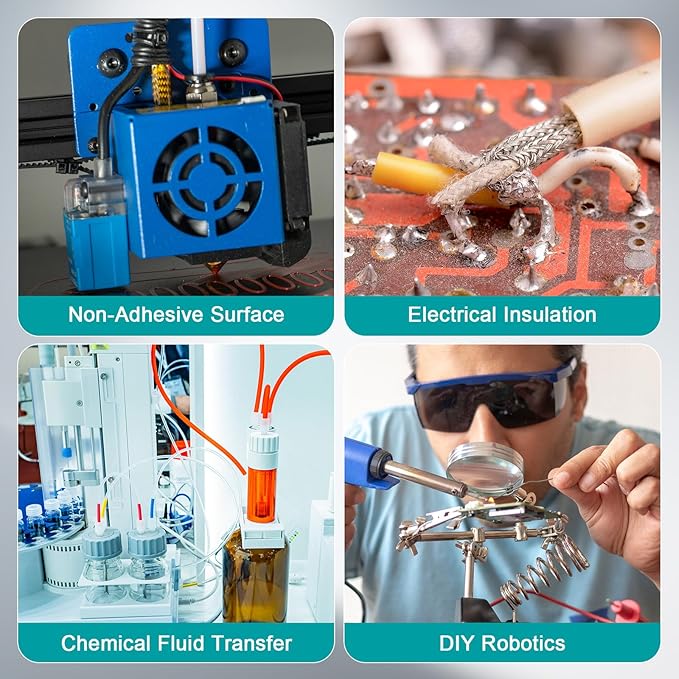
Different dosing equipment imposes different requirements. These are common application areas where PTFE capillary tubing may be considered.
Laboratory reagent dosing
Lab dosing systems deliver small quantities of reagents during testing, sample preparation, and chemical analysis. PTFE capillary tubing can connect reagent containers, pumps, valves, and dispensing components.
Key selection factors include:
- Chemical compatibility
- Internal diameter
- Tube length
- Flow rate requirements
- Connection dimensions
- Cleanliness requirements
If the equipment handles multiple reagents, evaluate compatibility and cleaning procedures together to avoid unwanted carryover.
Analytical instruments
Analytical instruments need carefully designed fluid paths to transfer samples, solvents, and reagents. PTFE capillary tubing is used in selected low-pressure fluid connections and sample-transfer applications.
Examples include:
- Laboratory chemical analyzers
- Chromatography-related equipment
- Sample preparation instruments
- Liquid analysis systems
- Automated testing equipment
Dimensional consistency and connection quality matter here. Poorly matched fittings or unnecessary dead volume can affect sample transfer and analytical performance. Pressure requirements also need a check-standard PTFE capillary tubing is not automatically suitable for high-pressure analytical systems.
Automated liquid handling systems
Automated liquid handling equipment uses pumps, valves, and dispensing components to move controlled amounts of liquid. PTFE capillary tubing may be considered for selected chemical delivery paths, especially where chemical resistance and compact dimensions are required.
Match the tubing specification to the equipment's flow requirements, operating pressure, and fluid characteristics.
Microfluidic equipment
Microfluidic systems handle small liquid volumes through narrow channels and connecting lines. PTFE capillary tubing can serve as a transfer connection between pumps, reservoirs, valves, and microfluidic devices.
For these setups, equipment manufacturers often focus on:
- Small and consistent internal diameter
- Accurate outer diameter
- Suitable wall thickness
- Tubing length
- Chemical resistance
- Connector compatibility
Evaluate the tube as part of the complete microfluidic system. Pressure stability and fluid behavior can also be affected by fittings, channel geometry, and operating conditions.
Industrial precision dispensing equipment
Precision dispensing is not limited to labs. Some industrial machines require controlled delivery of adhesives, chemical solutions, lubricants, or other process fluids. PTFE capillary tubing may suit selected fluid paths where chemical compatibility and small-bore tubing are required.
For repeated movement, high-frequency operation, or continuous pressure, review the tube's mechanical properties and service conditions before selection.
How Tube Size Affects Dosing Performance
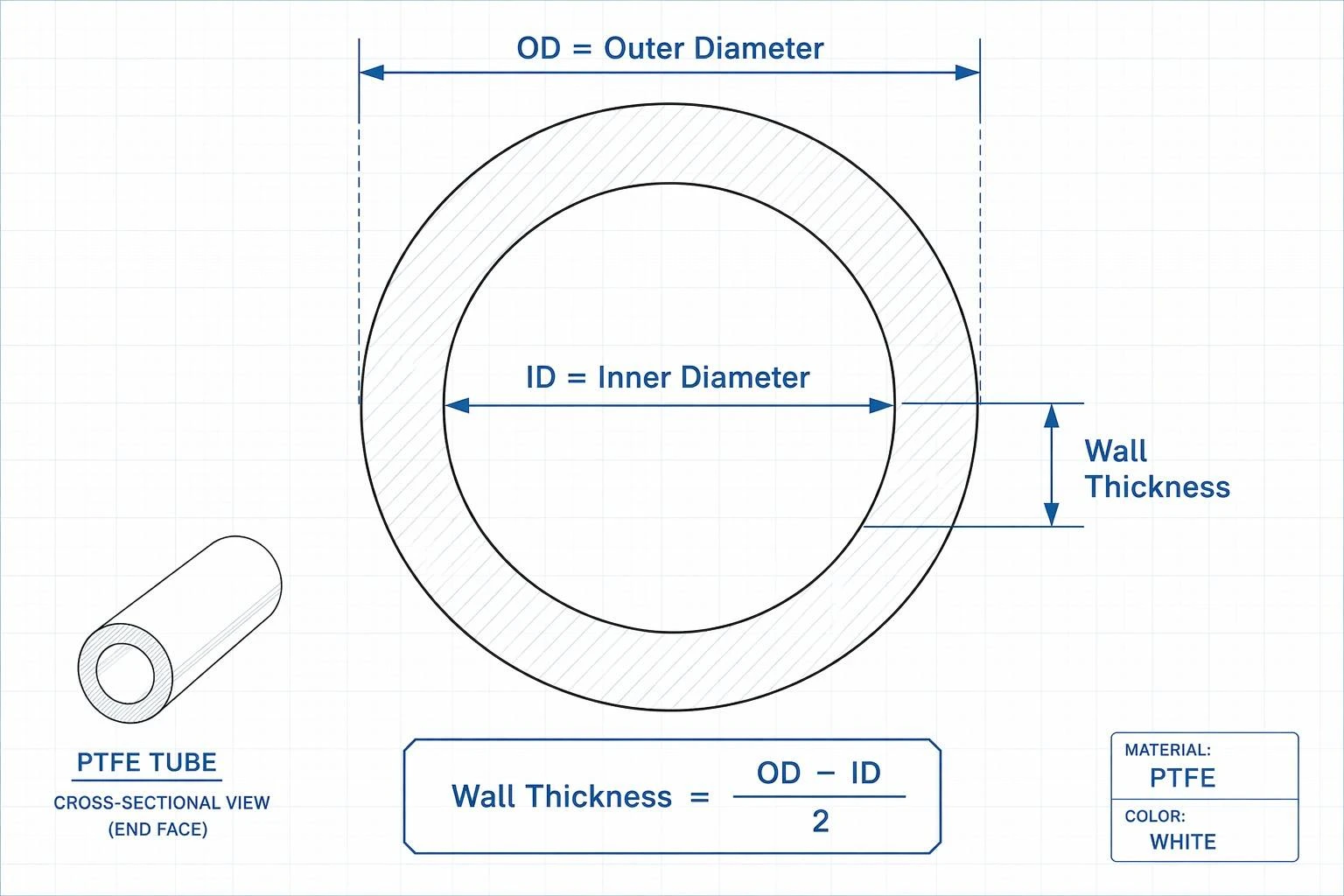

Tube size is one of the most important decisions in precision dosing. ID, OD, and wall thickness determine how the tube fits into the system and how it handles fluid.
Internal diameter (ID)
The ID sets the size of the passage through which liquid flows. For a given liquid and operating condition, changing the ID can significantly affect flow resistance.
In an ideal circular tube with steady laminar flow of a Newtonian fluid, the Hagen–Poiseuille relationship describes pressure drop and flow:
Q=πΔPr48μLQ=8μLπΔPr4
Where:
Q = volumetric flow rate
ΔP = pressure difference
r = internal radius
μ = dynamic viscosity
L = tube length
This is why ID gets so much attention: under idealized conditions, flow rate is proportional to the fourth power of the internal radius when other variables stay constant.
In real dosing equipment, pump behavior, fittings, entrance effects, fluid properties, and system calibration also affect the delivered volume. The formula is a useful warning, not a substitute for testing.
Outer diameter (OD)
The OD determines how the tube fits into connectors, compression fittings, and other components. If the OD does not match the fitting specification, installation problems or leakage can follow.
Before ordering, confirm the required OD and its dimensional tolerance with the equipment manufacturer or tubing supplier.
Wall thickness
Wall thickness affects mechanical strength and pressure capability. A thin-wall tube may provide a larger ID within a limited installation space, while a thicker-wall tube may offer different mechanical characteristics.
The right wall thickness depends on operating pressure, temperature, dimensions, and installation conditions.
Tube length
Length also matters. For a given ID and fluid, a longer tube generally creates greater pressure drop under laminar flow. It also increases the internal fluid volume of the delivery line.
In small-volume dosing, an unnecessarily long tube can increase liquid retention and affect response time. Consider length together with ID and the required dispensing volume-not after the tube has been cut.
How to Choose PTFE Capillary Tubing for Precision Dosing
Different dosing systems need different tubing specifications. Before purchasing, confirm these technical details.
Required flow rate
Start with the target flow rate or dispensing volume. A system that transfers a small amount of reagent per cycle may need a different tube specification from one that continuously supplies liquid.
Give the supplier the expected flow range and operating conditions. The supplier can help review suitable dimensions, but final flow performance should be verified in the actual equipment.
Fluid viscosity
Viscosity affects resistance to flow. Water-like liquids, solvents, oils, and concentrated chemical solutions behave differently inside a narrow capillary tube.
A higher-viscosity liquid generally needs more pressure to achieve the same flow rate under otherwise identical conditions. Specify temperature too, because it changes viscosity.
Tube dimensions and tolerances
For precision dosing, nominal dimensions alone are often not enough. Confirm:
| Specification | Why it matters |
|---|---|
| Inner diameter (ID) | Sets the fluid passage and affects flow resistance |
| Outer diameter (OD) | Ensures compatibility with connectors and fittings |
| Wall thickness | Influences mechanical strength and pressure capability |
| ID tolerance | Helps control variation in the flow passage |
| OD tolerance | Supports accurate fitting and installation |
| Tube length | Affects internal volume and system pressure drop |
For example, a PTFE capillary tube specified as 1 mm ID × 2 mm OD has a nominal wall thickness of 0.5 mm. Confirm actual dimensional tolerances with the manufacturer rather than assuming them from the nominal size.
Working pressure and temperature
The tubing must operate within its allowable service conditions. Confirm:
- Normal working pressure
- Maximum expected pressure
- Operating temperature
- Temperature fluctuations
- Continuous or intermittent operation
If the system uses pressure-driven dosing, consider the pressure required to overcome tubing resistance. Never determine pressure rating from the material name alone. Finished tube dimensions and operating temperature matter.
Connection and fitting compatibility
A properly selected capillary tube also has to work with the equipment's connection system. Check fitting type, connection dimensions, sealing method, and installation procedure.
In compact fluid systems, poorly matched connections can create dead volume, leakage, or inconsistent delivery. If possible, send a technical drawing or an existing tube sample to the supplier.
PTFE vs. PFA vs. FEP Capillary Tubing
PTFE, PFA, and FEP are common fluoropolymers in fluid handling. They share some chemical-resistance characteristics, but their properties and processing methods differ.
| Property | PTFE | PFA | FEP |
|---|---|---|---|
| Chemical resistance | Broad resistance | Broad resistance | Good resistance to many chemicals |
| Transparency | Often opaque or translucent | Available transparent | Available transparent |
| Temperature capability | Generally highest | High | Generally lower than PTFE and PFA |
| Surface properties | Low friction | Low friction | Low friction |
| Processing | PTFE-specific processes | Melt-processable | Melt-processable |
| Main selection considerations | Chemical compatibility and temperature | Transparency and specific high-purity requirements | Transparency and general fluid transfer |
PTFE capillary tubing: Consider it when broad chemical resistance, low friction, and higher-temperature capability are important.
PFA capillary tubing: Consider PFA when transparency, melt-processability, and certain demanding fluid-handling requirements matter.
FEP capillary tubing: Consider FEP when visual observation of the fluid is useful and its temperature, pressure, and chemical compatibility limits meet the application.
The best material depends on the actual liquid, operating conditions, and equipment design.
Explore our PTFE Capillary Tube range for small-diameter options. If transparency or high-purity fluid handling is part of the project, you can also review our PFA Tube and FEP Tube product pages.
Common Precision Dosing Problems and How to Avoid Them
A suitable PTFE capillary tube cannot guarantee accurate dosing if the rest of the fluid system is poorly designed. Watch for these issues.
Problem 1: Inconsistent flow rate
Flow variation may come from pressure changes, fluid viscosity, temperature, pump behavior, or tubing dimensions.
What to do: Check tube ID, length, operating pressure, fluid viscosity, and temperature. For demanding applications, verify flow performance through system testing and calibration.
Problem 2: Incorrect dispensing volume
The delivered volume may differ from target if the pump is not calibrated or if air bubbles, pressure fluctuations, or fluid-property changes occur.
What to do: Evaluate the complete dosing system, including pumps, valves, sensors, and tubing. Use a calibration procedure that matches the specific liquid and operating conditions.
Problem 3: Leakage at connections
Incorrect tube dimensions or unsuitable fittings can lead to leakage.
What to do: Confirm ID, OD, fitting specifications, and assembly requirements before production or installation.
Problem 4: Liquid retention in the tubing
A narrow or unnecessarily long tube can increase fluid retention and affect the response of a small-volume dosing system.
What to do: Calculate the tube's internal volume and select a suitable length and ID based on the required dispensing volume.
Problem 5: Chemical compatibility problems
Not all chemicals behave the same way, even within the same general chemical family.
What to do: Provide the exact chemical name, concentration, and operating temperature to the tubing manufacturer for compatibility evaluation.

Customized PTFE Capillary Tubing for OEM Equipment Manufacturers
Standard PTFE capillary tubing sizes can meet many general fluid-transfer requirements. But some equipment manufacturers need customized dimensions to match pump systems, connectors, or compact fluid paths.
Customized PTFE capillary tubing may include:
- Special internal diameters
- Customized outer diameters
- Specific wall thicknesses
- Controlled dimensional tolerances
- Custom cutting lengths
- Special color requirements
Production according to technical drawings or samples
At WITFLON, Hubei Zetai New Material Co., Ltd. provides PTFE tubing and other fluoropolymer products for industrial and medical applications. Our product range includes PTFE tubing, PTFE capillary tubing, PFA tubing, and FEP tubing.
We support customized tubing requirements for OEM projects, including dimensional specifications and sample evaluation. For precision dosing applications, share the required flow conditions, tube dimensions, chemical medium, and connection details so we can review the appropriate tubing specification before production.
Request Customized PTFE Capillary Tubing for Your Dosing Equipment
Looking for a PTFE capillary tubing supplier for your precision dosing system? Whether you need standard small-diameter PTFE capillary tubing or a customized tube for laboratory and industrial equipment, WITFLON can review your technical requirements and discuss suitable options.
To help us evaluate your project, please provide:
Application: Precision dosing, laboratory instruments, chemical dispensing, or other equipment
Required ID × OD: Tube dimensions and dimensional tolerances
Tube length: Required length per piece or roll
Chemical medium: Liquid name and concentration
Flow requirements: Target flow rate or dispensing volume
Operating conditions: Working pressure and temperature
Order quantity: Sample quantity and estimated production demand
Technical drawing: If available
Our team can review your specifications and discuss material options, customized dimensions, samples, and production arrangements.
Contact WITFLON today for a PTFE capillary tubing quotation. Send us your drawings or tube specifications to discuss a suitable solution for your precision fluid delivery equipment.
Frequently Asked Questions
1. What is PTFE capillary tubing used for in precision dosing?
PTFE capillary tubing is used in selected fluid delivery systems to connect pumps, valves, reservoirs, and dispensing components. Its small internal diameter and chemical resistance make it suitable for small-volume chemical transfer and controlled fluid delivery.
2. Does a smaller PTFE capillary tube provide more accurate dosing?
Not necessarily. A smaller ID increases hydraulic resistance and may reduce flow under the same pressure. Dosing accuracy depends on the pump, pressure control, fluid properties, tubing dimensions, and system calibration. Match the tube size to the application instead of simply choosing the smallest option.
3. How do I select the correct ID and OD for PTFE capillary tubing?
Start with required flow rate, working pressure, tube length, and fitting dimensions. Select the ID according to the required fluid passage and flow resistance, then confirm OD and wall thickness based on the connection system and mechanical requirements.
4. Can PTFE capillary tubing handle chemical reagents and solvents?
PTFE is resistant to many acids, alkalis, and organic solvents, so it is commonly considered for chemical reagent and solvent transfer. Compatibility must still be checked for the specific chemical, concentration, temperature, and exposure conditions.
5. Can I order customized PTFE capillary tubing for precision dosing equipment?
Yes. Customized PTFE capillary tubing may be available according to required ID, OD, wall thickness, dimensional tolerance, and cutting length. Provide a drawing or existing tube sample so the manufacturer can review production feasibility and specifications.