

Why PTFE Tubing Works for Laboratory Chemical Delivery
PTFE (polytetrafluoroethylene) brings a combination of chemical, thermal, and surface properties that fit many lab fluid-handling applications. Here's why equipment manufacturers keep coming back to it.
Excellent Chemical Resistance
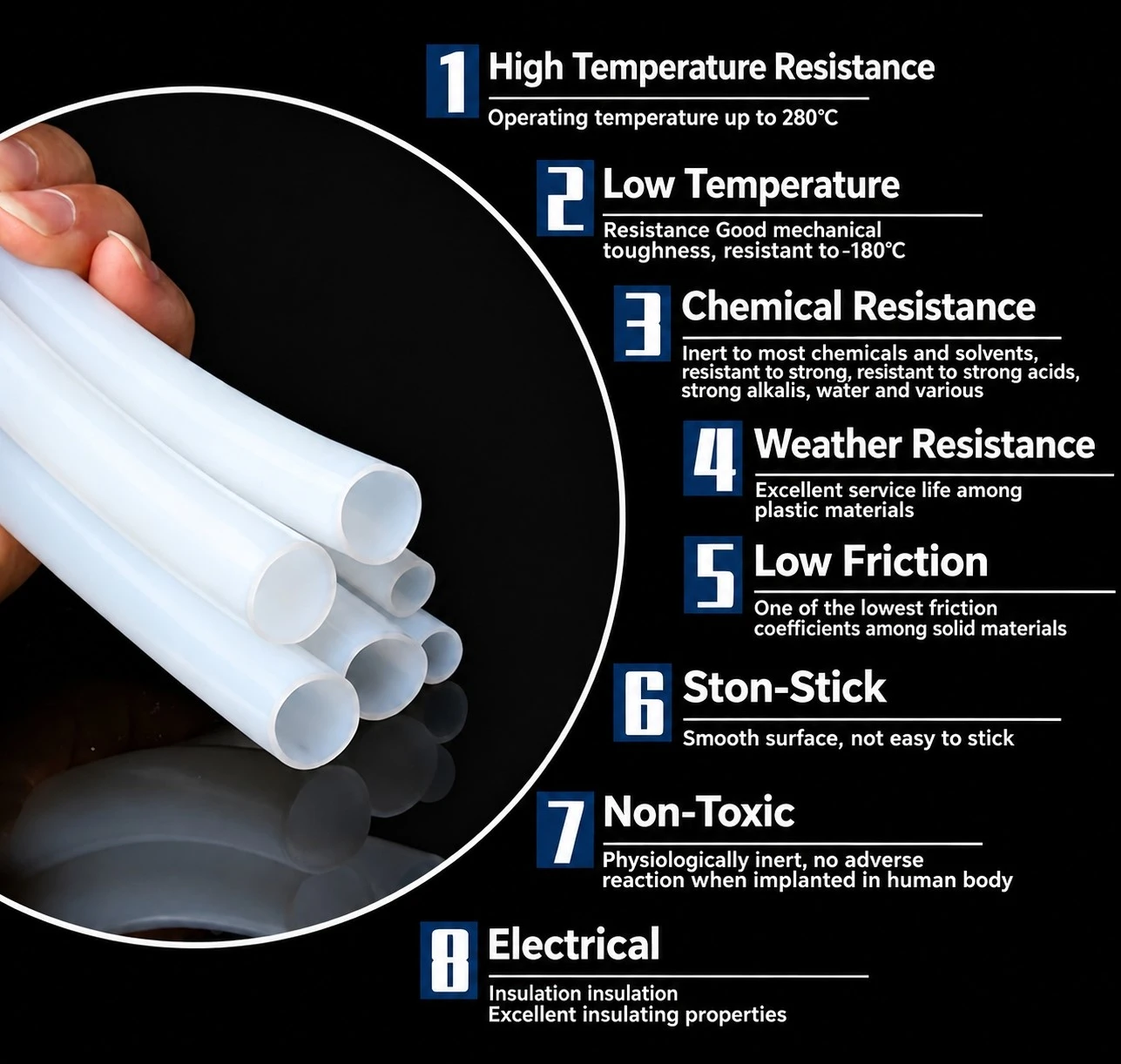
Lab systems handle acids, alkalis, organic solvents, reagents, cleaning solutions-the list goes on. PTFE offers broad resistance to many aggressive chemicals and is far less likely than conventional plastics to swell or degrade when exposed to compatible media.
This makes PTFE tubing a practical option for:
- Chemical reagent delivery
- Solvent transfer lines
- Laboratory chemical dosing systems
- Analytical instrument connections
- Chemical preparation equipment
Always check compatibility against the exact chemical, concentration, temperature, and exposure conditions. Some chemicals and operating conditions still need extra evaluation.
Low Friction, Smooth Internal Surface
PTFE's low-friction surface lets liquids move through the tube with relatively low resistance. In lab equipment, that matters when you're transferring small volumes or connecting narrow fluid paths.
A smooth bore can also make certain residues easier to remove during cleaning. But actual cleaning performance depends on the chemical, system design, and cleaning method. For sensitive samples, also consider material cleanliness, extractables, and potential carryover.
Good Thermal Stability
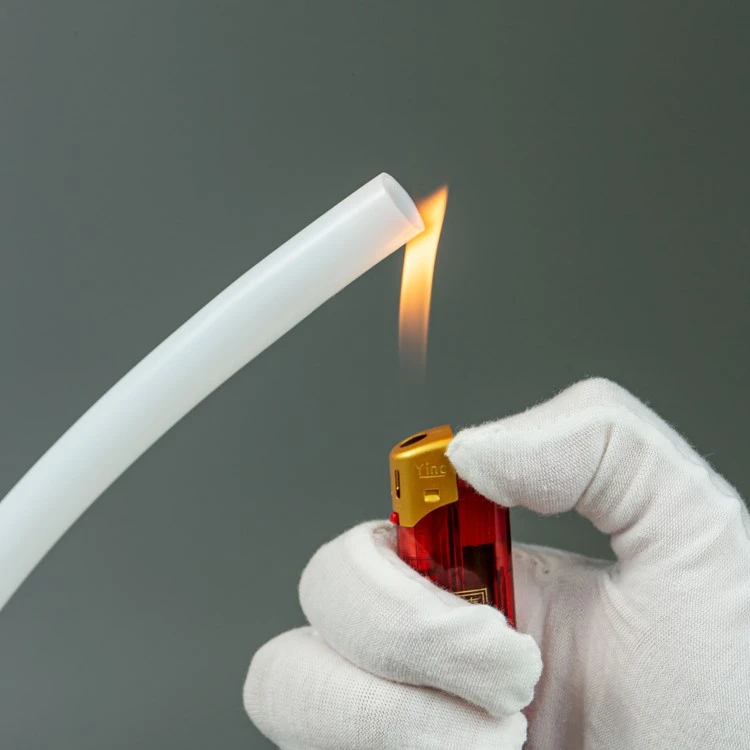
Lab equipment operates at different temperatures depending on the process and testing procedure. PTFE maintains useful properties across a broad temperature range, making it suitable for many heated or temperature-variable fluid applications.
The allowable service temperature of a finished tube must be confirmed based on its material grade, dimensions, pressure, and operating environment.
Electrical Insulation and Material Stability
In analytical instruments and automated lab equipment, tubing often runs alongside electrical components and sensors. PTFE provides excellent electrical insulation and good resistance to environmental aging under many service conditions.
Its chemical stability and low surface friction make it a practical material for fluid-handling systems where consistent tubing performance is critical.
Common Laboratory Applications for PTFE Tubing
Different instruments have different fluid-delivery requirements. Here are the common application areas where PTFE tubing may be considered.
Analytical Instruments
Analytical instruments need tubing to transfer reagents, solvents, and samples between components. PTFE tubing works in selected fluid paths where chemical compatibility and dimensional consistency are important.
Examples include:
- Chemical analyzers
- Chromatography-related fluid systems
- Sample preparation equipment
- Laboratory testing instruments
- Automated analytical equipment
For applications involving precise liquid volumes, evaluate the tube's internal diameter, length, and connection design together-not in isolation.
Laboratory Chemical Dosing Systems
Chemical dosing equipment delivers controlled quantities of liquids during experiments, testing, or sample prep. Small-diameter PTFE tubing may be suitable for reagent delivery lines and compact fluid paths.
Select the internal diameter based on flow rate, fluid viscosity, tubing length, operating pressure, and pump characteristics. If accurate dosing is required, the entire fluid-delivery system must be calibrated. PTFE tubing alone doesn't guarantee dosing accuracy.
Microfluidic and Small-Volume Fluid Systems
Microfluidic systems work with small liquid volumes and narrow channels. PTFE capillary tubing can serve as a connecting line between pumps, valves, reservoirs, and other components in selected setups.
In these applications, buyers typically focus on:
- Small and consistent internal diameters
- Accurate outer diameter
- Suitable wall thickness
- Chemical compatibility
- Connection and fitting compatibility
- Repeatable dimensional tolerances
For equipment manufacturers, customized PTFE capillary tubing can help meet specific installation and fluid-path requirements.
Laboratory Pumps and Fluid Transfer Equipment
Peristaltic pumps, dosing pumps, and other lab fluid-transfer devices need tubing with suitable dimensions and mechanical properties. When selecting PTFE tubing, check whether the pump mechanism is compatible with PTFE. Not all PTFE tubing is suitable for repeated compression in a peristaltic pump.
For applications involving continuous bending or repeated compression, evaluate the tubing's flexibility, fatigue resistance, and intended service life. Other materials may be more appropriate depending on the pump design.
Chemical Storage and Dispensing Equipment
PTFE tubing can also connect chemical containers, dispensing valves, and fluid-transfer components. Its chemical resistance makes it useful for selected chemical delivery lines, especially when the fluid is incompatible with conventional tubing.
The complete assembly-fittings, seals, valves, and containers-must be compatible with the chemical being handled.
PTFE Capillary Tubing vs. Standard PTFE Tubing for Lab Use
One key decision for lab equipment manufacturers: standard PTFE tubing or PTFE capillary tubing? Both are made from PTFE, but their dimensions and intended applications differ.
| Comparison | Standard PTFE Tubing | PTFE Capillary Tubing |
|---|---|---|
| Typical dimensions | Various small and large sizes | Usually small internal diameters |
| Main purpose | General fluid transfer | Narrow fluid paths and small-volume delivery |
| Flow requirements | General fluid circulation or transfer | More controlled flow through small passages |
| Common applications | Chemical supply lines and equipment connections | Analytical instruments and microfluidic connections |
| Key selection factors | ID, OD, wall thickness, pressure | ID tolerance, OD tolerance, wall thickness, flow requirements |

When to choose standard PTFE tubing: It suits many general lab chemical-transfer lines where the required dimensions and operating conditions fall within available specifications.
When to choose PTFE capillary tubing: Consider it when the equipment needs a smaller internal diameter, compact fluid paths, or specific dimensional tolerances.
For precision lab systems, confirm actual ID and OD tolerances with the manufacturer before ordering.
Explore our PTFE Capillary Tube product range for small-diameter options.
PTFE vs. PFA vs. FEP Tubing for Laboratory Applications
PTFE isn't the only fluoropolymer used in lab fluid systems. PFA and FEP are also common, especially when transparency or specific manufacturing characteristics matter. Here's how they compare:
| Property | PTFE | PFA | FEP |
|---|---|---|---|
| Chemical resistance | Broad resistance | Broad resistance | Good resistance to many chemicals |
| Transparency | Generally opaque | Available transparent | Available transparent |
| Temperature capability | Generally highest among these three | High | Generally lower than PTFE and PFA |
| Surface characteristics | Low friction | Low friction | Low friction |
| Processing | PTFE-specific methods | Melt-processable | Melt-processable |
| Typical selection priority | Chemical resistance and temperature performance | Transparency and demanding chemical applications | Transparency and general chemical fluid transfer |
Which Material Should Lab Buyers Choose?
PTFE tubing: A suitable candidate when broad chemical resistance, low friction, and high-temperature capability are important.
PFA tubing: Worth considering when transparency, melt-processability, and certain high-purity fluid-handling requirements are needed.
FEP tubing: A practical option when visual observation of fluid movement is useful and operating temperature and pressure are within its limits.
The final choice depends on the exact chemical, operating conditions, required cleanliness, and material grade.
You can also explore our PFA Tube and FEP Tube product ranges.
How to Choose the Right PTFE Tubing for Lab Chemical Delivery

Picking a tube based only on the material name isn't enough. Lab equipment manufacturers should review these technical details before confirming an order.
Chemical Compatibility
Start by identifying the liquid that will pass through the tubing. Provide your supplier with:
Chemical name
Chemical concentration
Mixture composition, if applicable
Operating temperature
Contact duration
Whether the fluid is continuously or intermittently transferred
An acid-transfer line and an organic-solvent delivery line may both use PTFE, but their complete operating conditions still need separate evaluation.
Internal Diameter (ID)
The ID determines the available flow passage. In lab systems, an unsuitable ID can affect flow rate, pressure drop, and the volume of liquid retained inside the tubing.
A smaller ID may suit compact fluid paths and small-volume delivery. Larger IDs may be required for higher flow rates. Determine the required size based on fluid properties, pump performance, tube length, and system pressure.
Outer Diameter (OD) and Wall Thickness
The OD affects compatibility between the tube and its fittings. Wall thickness influences mechanical strength and pressure capability.
For equipment manufacturers, confirm these dimensions before production to avoid installation problems.
A complete tube specification should include:
ID × OD × Wall Thickness
For example, a tube with an ID of 1 mm and an OD of 2 mm has a nominal wall thickness of 0.5 mm.
Dimensional Tolerance
Dimensional tolerance is especially important in lab equipment with compact fluid paths and precision fittings. A tube may have the correct nominal dimensions but still cause installation issues if actual dimensions vary too much.
Before ordering, confirm:
ID tolerance
OD tolerance
Wall thickness consistency
Straightness or coiling requirements, where applicable
Required cutting length
If your equipment uses a special connector, providing a drawing or sample helps the manufacturer evaluate the required dimensions.
Cleanliness and Material Requirements
Some lab applications involve sensitive samples or high-purity chemicals. In these cases, specify additional requirements such as:
Virgin PTFE or a specified material grade
Controlled manufacturing cleanliness
Suitable packaging
Batch identification
Material or inspection documentation
Extractables or leachables evaluation, where required
Distinguish general chemical resistance from high-purity suitability. A standard industrial PTFE tube should not automatically be treated as suitable for every analytical or high-purity process.
Common Problems in Laboratory Fluid Systems (and How to Fix Them)
Even with the right material, problems crop up when tubing dimensions or installation conditions aren't properly selected. Here's what to watch for
Problem 1: Inconsistent Liquid Flow
An unsuitable ID, excessive tubing length, or incorrect connection can affect flow rate.
What to do: Review required flow rate, fluid viscosity, tubing ID, line length, and pump specifications before selecting the tube.
Problem 2: Sample Carryover or Contamination
Residues from previous samples, manufacturing residues, unsuitable cleaning procedures, or incompatible components can affect sensitive testing.
What to do: Specify cleanliness requirements and evaluate the complete fluid path-tubing, fittings, valves, and cleaning procedures.
Problem 3: Leakage at Tube Connections
Leaks occur when the tube OD doesn't match the fitting, the connection is incorrectly assembled, or the system operates beyond its allowable limits.
What to do: Confirm tube dimensions, fitting specifications, connection method, and working pressure.
Problem 4: Difficulty Installing Small-Diameter Tubing
Small PTFE tubes can be difficult to install if dimensions don't match the equipment design.
What to do: Provide a technical drawing or existing tube sample. Confirm ID, OD, wall thickness, tolerance, and required length before placing a production order.
Problem 5: Tubing Deformation During Operation
Temperature, pressure, bending, and mechanical stress can affect tubing shape and performance.
What to do: Evaluate the complete operating environment-continuous pressure, temperature changes, minimum bending radius, and mechanical movement.
Customized PTFE Tubing for Laboratory Equipment Manufacturers
Standard tubing sizes work for many lab applications. But OEM equipment manufacturers often need special dimensions or configurations to match their fluid-system designs.
Customized PTFE tubing can be considered for projects requiring:
Non-standard ID and OD
Specific wall thickness
Small-diameter capillary tubing
Custom cutting lengths
Special colors or identification requirements
Tubing produced according to samples or technical drawings
At WITFLON, Hubei Zetai New Material Co., Ltd. specializes in industrial and medical-grade fluoropolymer tubing and PTFE products. Our range includes PTFE tubing, PTFE capillary tubing, PFA tubing, FEP tubing, and customized fluoropolymer solutions.
We support OEM projects, sample evaluation, and customized production according to confirmed technical requirements. For lab chemical delivery projects, we recommend confirming the chemical medium, dimensions, operating conditions, and connection requirements before selecting the final tubing specification.
Request PTFE Tubing for Your Laboratory Chemical Delivery System
Looking for a reliable PTFE tubing supplier for lab equipment or chemical delivery applications? Whether you need standard PTFE tubing, small-diameter PTFE capillary tubing, or customized dimensions, our team can review your requirements and discuss suitable product options.
To help us understand your project, please provide:
Application: Laboratory analyzer, dosing system, chemical delivery equipment, or other applications
Chemical medium: Chemical name and concentration
Tube dimensions: Required ID × OD and wall thickness
Operating conditions: Temperature and working pressure
Quantity: Estimated sample or production order quantity
Drawing or sample: If available
Send your specifications to WITFLON to discuss material selection, dimensional requirements, samples, and customized production.
Contact us today for a PTFE tubing quotation.
Frequently Asked Questions
1. Is PTFE tubing suitable for laboratory chemical delivery?
Yes. PTFE tubing is used in many lab fluid-transfer applications because it offers broad chemical resistance, low friction, and good thermal stability. Suitability depends on the specific chemical, concentration, temperature, pressure, and cleanliness requirements.
2. What size PTFE tubing is commonly used in laboratory equipment?
There's no single standard size for all lab equipment. Small-diameter PTFE capillary tubing may be used in analytical instruments and compact fluid paths, while larger PTFE tubing may be required for general chemical transfer. The correct size should be determined by equipment design, required flow rate, and fitting dimensions.
3. Is PTFE capillary tubing suitable for microfluidic applications?
PTFE capillary tubing can be used as a connecting line in selected microfluidic systems. Confirm internal diameter, dimensional tolerance, pressure requirements, chemical compatibility, and connection design before selecting a tube.
4. Should I choose PTFE, PFA, or FEP tubing for laboratory use?
PTFE is often considered for broad chemical resistance and higher-temperature applications. PFA may be preferred when transparency and certain high-purity requirements are important. FEP is another option for transparent chemical-transfer lines with suitable operating conditions. The final selection depends on the actual application and material grade.
5. Can PTFE tubing be customized according to laboratory equipment drawings?
Yes. Customized PTFE tubing may be available according to required ID, OD, wall thickness, length, and other specifications. Provide a technical drawing or existing sample so the manufacturer can review production feasibility and dimensional requirements.